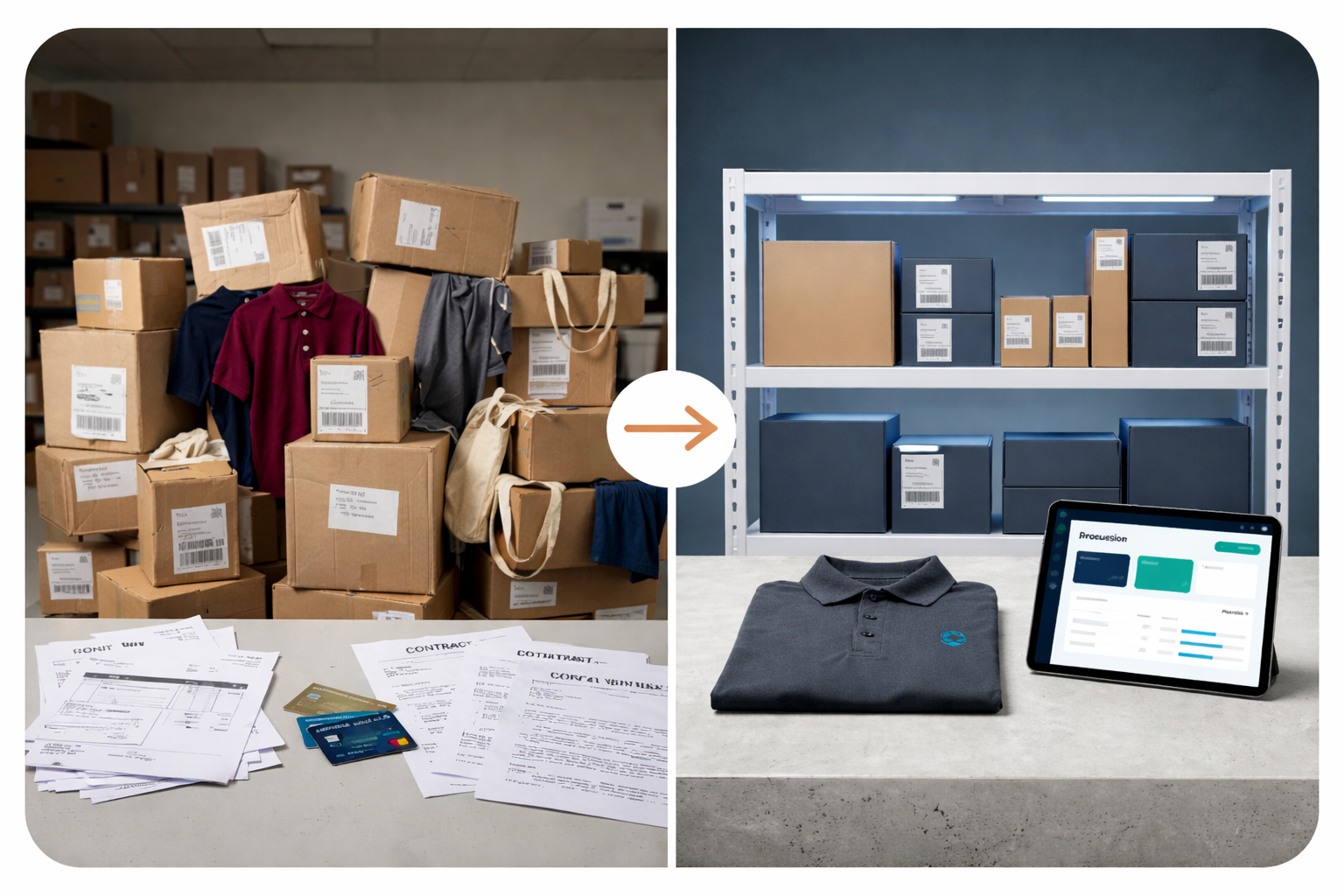
Growth is the primary objective for most organizations, but without the right infrastructure, growth creates complexity. As distributed teams expand, new locations open, and departments scale, the number of suppliers naturally balloons. Marketing teams in different regions hire their own print vendors to hit tight deadlines. HR departments manage separate contracts for recognition programs to support rapid hiring. Operations leaders procure uniforms and safety gear from local suppliers to keep the lines moving.
In the moment, these decisions feel like agility. In aggregate, they look like chaos.
Before long, the organization is managing hundreds of redundant relationships. Procurement loses visibility, administrative overhead multiplies, and the brand experience becomes fragmented. What was intended to be a localized solution becomes a systemic liability.
This phenomenon is known as vendor sprawl, and it is a silent killer of operational efficiency.
Vendor consolidation is often viewed solely as a cost-cutting tactic, a way to squeeze a few percentage points out of unit costs. But for distributed organizations, it is much more than that; it is a governance system. By moving from a chaotic web of local suppliers to a vendor consolidation strategy, organizations regain control over their spend, brand consistency, and operational sanity.
We believe that managing apparel, print, and branded materials across distributed teams requires one reliable system, not a dozen disconnected vendors. Here is how consolidation restores infrastructure and reduces risk.
Why Operational Costs Increase as Organizations Scale
The correlation between organizational scale and operational inefficiency is almost linear. When a company adds a new location or a new division, the path of least resistance is often for that team to find their own local partners for immediate needs, whether that’s branded merchandise, signage, or operational supplies.
This decentralized procurement creates a structural problem that bleeds budget from multiple arteries.
First, there is the loss of purchasing power. When five different departments buy the same category of goods from five different suppliers, resulting in vendor sprawl, the organization pays a premium on every transaction. You lose the ability to negotiate volume pricing because your volume is fractured. You duplicate shipping costs, paying for individual courier shipments instead of consolidated freight.
But the financial impact goes deeper than the invoice price. The real cost lies in spend management and administrative drag.
Every additional vendor requires a lifecycle of administrative labor:
- Onboarding: Vetting, tax documentation, and system entry.
- Contract Management: Legal review and renewals.
- Transaction Processing: Generating purchase orders and approving invoices.
- Performance Review: Chasing down delivery times and quality issues.
Research from The Hackett Group suggests that world-class procurement organizations consolidate their purchasing among 78% fewer suppliers than their peers. Why? Because they understand that spend visibility is impossible when data is scattered across fragmented systems. When you cannot see what you are spending, you cannot control it.
In a distributed environment without consolidation, you are essentially paying your highly qualified finance and operations teams to manage data entry for hundreds of low-value transactions, rather than focusing on strategic growth.
What Is Vendor Consolidation? (And How It Differs from Supplier Consolidation)
To fix the problem, we must define the solution accurately. In the procurement world, terms are often thrown around loosely, but precision matters when building a strategy.
Vendor consolidation is the strategic process of reducing the number of suppliers within a specific category or across the entire supply chain to a manageable, high-performing few. It involves auditing your current supply base, identifying redundancies, and migrating volume to partners who can handle scale. It is not just about cutting numbers; it is about upgrading the quality of the remaining relationships.
While the terms are often used interchangeably, there is a nuance between supplier consolidation and vendor consolidation in practice:
- Supplier Consolidation: This is often a tactical exercise. It usually refers to the reduction of suppliers to get a better price on a specific SKU or commodity. For example, a company might realize it buys office paper from three different companies and decides to buy it all from one to save 10%. It is transactional.
- Vendor Consolidation: This is a broader, structural approach. It looks at reducing the total number of relationships required to run the business. It is a form of strategic sourcing that prioritizes partners who can service multiple needs, such as a single partner managing print, warehousing, fulfillment, and online ordering, rather than just selling a product.
This is a critical cost reduction strategy, but it is also an operational upgrade. It shifts the relationship from transactional (buying stuff) to structural (building a system). When you consolidate, you are not just asking for a lower price; you are asking for a partner who can integrate with your ERP, manage your inventory risk, and protect your brand standards across every location.
The Hidden Cost of Decentralized Procurement
The obvious cost of using too many vendors is paying too much for goods. The hidden cost is the erosion of procurement governance. This is the cost that doesn’t show up on a P&L as a single line item, but slowly degrades the bottom line.
When procurement is decentralized, no single team has ownership. Marketing buys swag for an event; HR buys gifts for onboarding; Sales buys kits for a conference. Each transaction happens in a silo, often on credit cards, bypassing formal approval workflows.
Decentralized procurement leads to four major hidden costs:
1. Contract Duplication and Inefficiency
We frequently see organizations with multiple agreements for the same services, often with the same parent vendor operating under different local branches, with vastly different terms. One department might have net-60 terms, while another pays up front. This inconsistency reduces spend visibility and makes cash flow forecasting impossible.
2. Administrative Bloat
The soft costs of procurement are substantial. Data estimates that the cost of manually processing a single invoice ranges between $15 and $40, factoring in labor, technology, and error resolution. If your distributed teams are generating thousands of low-value invoices from hundreds of local vendors, you are bleeding operational budget just to pay the bills.
3. Compliance and Liability Risk
Local vendors often skip the rigorous vetting process required by corporate legal teams. This introduces risk. Do they meet your insurance requirements? Do they comply with data privacy laws (GDPR/CCPA) if they are handling employee shipping addresses? Do their labor practices align with your ESG goals? When you have 500 vendors, you cannot verify this. When you have five, you can.
4. Poor Data Quality
You cannot analyze spend patterns because the data doesn’t exist in a unified format. One vendor categorizes a polo shirt as “Uniforms,” another as “Marketing,” and a third as “Office Supplies.” Without normalized data, your finance team cannot identify trends or forecast accurate budgets.
According to Deloitte, accurate financial reporting depends on the alignment of procurement data. When that data is fractured, strategic decision-making becomes impossible.
Maverick Spending and Vendor Sprawl in Distributed Teams
The most dangerous byproduct of decentralized operations is maverick spending.
Maverick spending (or rogue spend) refers to purchases made by employees outside of agreed-upon contracts or established procurement channels. In distributed organizations, like franchises, dealer networks, or multi-location brands, this is rampant.
It is rarely malicious. It is usually a symptom of a broken system.
Why does it happen? Usually, because the corporate procurement process is perceived as too slow, too rigid, or simply nonexistent. A branch manager needs branded polos for a community event next week. If there is no approved vendor list that is easy to access, or if the “official” vendor takes three weeks to ship, that manager will solve the problem the only way they know how: they will go to a local shop, use a corporate card, and expense it.
This individual decision makes sense for the branch manager, but it contributes to organizational vendor sprawl. Suddenly, you have 50 different branches using 50 different screen printers.
- The quality varies (one shirt shrinks, one fades).
- The logos are inconsistent (different threads, different sizing).
- Headquarters has zero visibility into the total spend until the expense reports come in weeks later.
Procurement governance is not about policing employees; it is about providing a system that is easier to use than going rogue. If you provide a centralized company store or a streamlined ordering portal that offers Amazon-like ease of use, you eliminate the friction that causes maverick spend. Employees want to do the right thing; the infrastructure just has to let them.
How Vendor Fragmentation Impacts Brand, Budget & Performance
At Inch, we see the impact of fragmentation specifically in the world of apparel, print, and recognition. These are categories where vendor sprawl is notoriously high because they touch so many different departments: Marketing, HR, Sales, and Operations all dip into this bucket.
When these categories are fragmented, the damage is visible and tangible:
Inconsistent Branded Materials & Quality Variance
A brand is defined by consistency. When procurement is fragmented, brand control is lost. One team uses an outdated logo; another uses the wrong Pantone color because their local vendor “got it close enough.” Beyond aesthetics, quality variance becomes a daily issue. One branch receives premium polos, while another gets flimsy, shrinking fabrics that look unprofessional. Over time, this inconsistent presentation dilutes the brand equity you have spent millions building. A centralized vendor acts as a brand guardian, ensuring that every asset produced meets strict corporate guidelines.
Inventory Duplication
This is the classic “closet problem.” Without a consolidated system, you experience massive inventory duplication. You might have 5,000 brochures sitting unused in a supply closet in Chicago, while the New York office is rushing a reprint order of the exact same asset. You are paying for production and storage twice. Consolidated vendors provide centralized inventory visibility, allowing you to draw down existing stock across the organization before spending money on new production.
Delayed Fulfillment
Without a unified fulfillment partner, you are at the mercy of dozens of different shipping schedules and unpredictable local shop capacities. Coordinating a product launch, an onboarding kit rollout, or a holiday gift across 50 locations becomes a logistical nightmare involving 50 different tracking numbers and inevitable delayed fulfillment. A consolidated partner can kit, pack, and ship to all locations simultaneously, ensuring a unified, on-time experience.
Budget Leakage
Decentralized buying means you are paying premium spot prices instead of leveraging organizational volume. Branch managers may pay expedited shipping on small orders or accept higher unit costs because they don’t have the time to shop around. This silent budget leakage drains resources month after month; capital that should be allocated to strategic growth rather than transactional overpayments.
Procurement Inefficiency
Every localized transaction requires someone to source the item, approve the proof, process the payment, and file the expense report. This creates a massive administrative burden, leading to severe procurement inefficiency. Operations and finance teams waste hours chasing down receipts and reconciling credit card statements instead of optimizing supply chains.
Recognition Program Breakdown
Employee recognition programs fall flat when the rewards arrive late or look cheap. Recognition program breakdown happens quickly when fulfillment isn’t centralized. If one regional office receives high-end jackets and another receives budget t-shirts because they used different local vendors, you haven’t built culture. A unified system ensures absolute equity in the employee experience.
By treating these categories as separate, transactional purchases, organizations introduce unnecessary risk. Consolidating them under one partner who manages production, inventory, and fulfillment transforms a logistical headache into a streamlined operation.
The Benefits of Vendor Consolidation Across Distributed Operations
Implementing a robust vendor consolidation program yields immediate and long-term value. According to Gartner, many organizations are targeting significant reductions in vendor counts to reduce complexity.
The benefits of vendor consolidation go beyond a simple cost reduction strategy:
1. Improved Price Leverage
Buying power comes from volume. When you aggregate spend from fifty locations to a single partner, you move from being a small customer to a strategic account. This unlocks tier-based pricing, volume rebates, and better contract terms. You are no longer paying “spot market” prices for every print job.
2. Standardized Quality Control
One system means one standard. You ensure that every piece of branded material, whether it lands in Seattle, Miami, or London, meets the same quality benchmarks. This consistency builds trust with your internal teams (who know they will get good stuff) and your external customers (who see a professional brand).
3. Reduced Administrative Overhead
Processing one invoice is cheaper than processing one hundred. Consolidating vendors dramatically reduces the workload on AP and Finance teams. Instead of chasing down receipts from field reps, they receive a single, consolidated monthly invoice with cost-center coding already applied. This frees them to focus on strategic initiatives rather than data entry.
4. Increased Spend Visibility
With a centralized partner, you get unified reporting. You can see exactly which locations are ordering what, where budget is being drained, and where efficiencies can be found. You can answer questions like, “How much did we spend on onboarding kits last year?” with a single click, rather than a week of spreadsheet aggregation.
5. Stronger Supplier Performance Management
It is easier to manage one strategic sourcing relationship than fifty transactional ones. When you have a dedicated account team, you can hold them accountable for SLAs, delivery times, and error rates. If a problem arises, you have one phone number to call to fix it, rather than navigating a phone tree.
A Practical Vendor Consolidation Strategy for Distributed Organizations
Moving from fragmentation to consolidation requires a deliberate vendor consolidation strategy. You cannot simply cut vendors overnight without a plan to support your distributed teams; that is a recipe for operational paralysis.
Here is a strategic framework for approaching the shift toward effective spend management:
1. Audit Your Footprint
You cannot fix what you do not measure. Start with a rigorous analysis of who you are paying. Pull accounts payable records for the last 12 months and categorize spend by supplier type (e.g., Print, Apparel, Promo, Logistics). Look for the “tail spend”, the hundreds of small vendors that make up the bottom 20% of your spend but 80% of your administrative volume.
2. Identify Duplication
Look for category overlap. How many different vendors are providing essentially the same service? Do you have three different vendors for business cards? Four for signage? These are your immediate targets for consolidation.
3. Analyze Fulfillment Fragmentation
Look at the logistics. Are you paying for storage in five different cities? Are you shipping globally from a provider who only handles domestic freight efficiently? Often, the cost savings in logistics alone justify the consolidation effort.
4. Assess Supplier Performance
Don’t just look for the cheapest vendor; look for the most capable one. Which vendors are true partners? Who has the technology to integrate with your systems? Who effectively manages supplier performance management? The goal is to find a partner who can scale with you, not just sell to you.
5. Establish an Approved Vendor List
Define the “golden path.” Create a preferred list of partners who meet your governance, quality, and technological requirements. This list should be communicated clearly to all stakeholders.
6. Consolidate Under Centralized Sourcing
Begin migrating volume. Start with the categories that have the highest fragmentation and highest maverick spend risk (usually branded merchandise and print). Move these to a centralized ordering platform to demonstrate immediate wins in efficiency and visibility.
This approach ensures that procurement consolidation is data-driven and minimizes disruption to your field teams.
The Vendor Consolidation Process (Step-by-Step Implementation)
Execution is where most strategies fail. A successful vendor consolidation process must be managed as a change management initiative, not just a procurement project. You are asking people to change their habits, and that requires clear communication.
Step 1: Discovery & Spend Audit
Gather data, but also gather stories. Interview stakeholders in Marketing, HR, and Operations to understand why they use their current vendors. Is it price? Speed? Relationship? You need to understand the functional needs before you change the solution. If a local branch uses a specific vendor because they offer 24-hour rush delivery, your new consolidated partner must be able to match that service level.
Step 2: Supplier Rationalization
Evaluate your current supply base against your future needs. We recommend looking for partners who offer “system” capabilities, online ordering portals, real-time inventory tracking, and integrated fulfillment, rather than just production capabilities. The vendor of the future is a technology partner as much as a manufacturer.
Step 3: Transition Planning
Map out the migration. If you are moving inventory from local closets to a centralized warehouse, plan the logistics. If you are launching a new ordering portal, plan the training. Set clear timelines for when old vendor contracts will be terminated and when the new system goes live.
Step 4: Communication to Distributed Teams
Explain the “why.” Distributed teams often resist centralization because they fear losing speed or control. Your communication needs to show them how the new system will make their jobs easier:
- “No more filing expense reports for print orders.”
- “Orders ship same-day from a central warehouse.”
- “No more designing flyers from scratch.”
Step 5: Governance Enforcement
Launch the approved vendor list and close the loopholes. This might involve restricting PCard usage for certain categories or requiring POs for non-standard vendors. However, the best enforcement is a superior user experience. If the new system is better, people will use it.
Step 6: Ongoing Performance Monitoring
Consolidation is not a “set and forget” project. Establish quarterly business reviews (QBRs) with your consolidated partners to review spend management metrics and identify further efficiencies. Use this data to continually refine the program.
Vendor Consolidation vs Vendor Management Strategy
It is important to distinguish between consolidation and management. They are two sides of the same coin.
Vendor consolidation is a structural change. It is the act of shrinking the supply base to improve infrastructure during a “cleanup” phase, where you remove the noise and simplify the system.
Vendor management strategy is the ongoing discipline of overseeing the partners that remain. It involves relationship building, risk assessment, and continuous improvement. It is the “maintenance” phase.
You need both. Consolidation gives you the leverage; management ensures you keep getting value. Top-performing companies use these strategies to drive innovation, not just savings. By consolidating, you free up the bandwidth to actually manage your strategic partners effectively, rather than just chasing paper. Instead of managing 50 relationships poorly, you manage three relationships excellently.
When Vendor Consolidation Makes Strategic Sense
Vendor consolidation is not necessary for every business. If you are a single-location startup with low volume, using local vendors is fine. You likely have the visibility you need just by walking across the office.
However, this strategy becomes essential and urgent for:
- Multi-Location Brands: Where brand consistency is non-negotiable across regions and local interpretation of the brand damages the company image.
- Franchise Systems: Where franchisees need easy access to approved materials without going rogue, and the franchisor needs to protect the brand standard.
- Enterprise Sales Teams: Who need consistent onboarding kits and event materials delivered globally to ensure every rep looks professional.
- Organizations Running Company Stores: Where inventory must be managed centrally to avoid waste and ensure fair access to merchandise.
- Businesses Managing Recognition Programs: Where the employee experience must be uniform, regardless of location, to ensure equity and morale.
In these scenarios, the cost of inaction is high. The fragmentation slows you down, dilutes your brand, and leaks budget.
We build our business around being the “one reliable system” for organizations facing this exact complexity. We don’t just sell products; we provide the operational infrastructure that allows you to consolidate, govern, and scale. We replace the chaos of the “many” with the reliability of the “one.”
Identify vendor duplication, maverick spend risk, fulfillment fragmentation, and cost inefficiencies across your distributed operations.