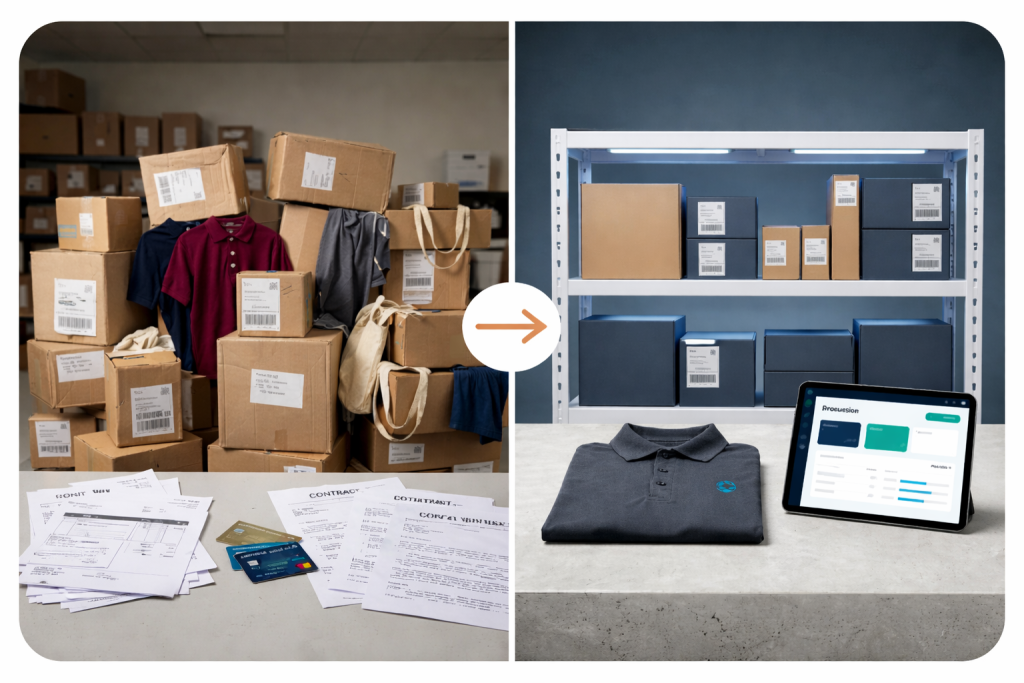
Most organizations believe that brand consistency is a creative challenge. They assume that if they produce enough rigorous brand guidelines, distribute enough PDF rulebooks, and host enough town halls about “voice and tone,” the brand will remain intact.
But when you look at where consistency actually breaks down, especially in mid-market and enterprise organizations, it rarely happens because a designer didn’t know which hex code to use. It happens because a field sales rep in Chicago needed 500 brochures for an event tomorrow and used a local printer that didn’t have the latest files, or because a newly acquired franchise in Texas ordered staff uniforms from a vendor that hadn’t been vetted for quality.
In reality, maintaining brand consistency at scale isn’t a design question. It is an infrastructure question.
At scale, brand guidelines are necessary, but on their own, they are insufficient. A PDF cannot stop a rogue vendor. A style guide cannot manage inventory levels across twenty satellite offices. To ensure your brand shows up the same way in a boardroom presentation as it does on a trade show floor or in a new employee’s welcome kit, you need operational controls, not just creative standards.
We have found that the larger the organization, the harder it is to maintain brand consistency across teams, locations, and partners without a centralized system of record. When you treat consistency as a logistics and distribution problem, the solution shifts from “more education” to “better infrastructure.”
Below, we break down why consistency fails at the operational level and the frameworks required to fix it.
Why Maintaining Brand Consistency Breaks at Scale
According to recent data from Gartner, 84% of companies describe themselves as stuck in a “brand doom loop,” a cycle where strategy is disconnected from execution, leading to diminished C-suite influence and inconsistent market presence. This loop doesn’t exist because the strategy is bad; it exists because the execution is decentralized and unmonitored.
When we analyze maintaining brand consistency in complex organizations, we see specific operational fracture points. These are not moments of creative failure, but moments of process failure.
Decentralized Ordering
In many organizations, “democratized” purchasing is viewed as a way to move fast. Marketing teams allow regional offices or department heads to use corporate credit cards for “small” purchases. While this solves an immediate speed problem, it creates a massive consistency gap.
When ten different department heads are empowered to source their own materials, you effectively have ten different versions of your brand entering the market. One team prioritizes speed, another prioritizes cost, and another prioritizes quality. The result is a fragmented brand experience where the “premium” brand promise is undercut by “budget” execution in the field.
Rogue Vendors
The “swag guy” down the street is one of the biggest threats to brand integrity. Local teams often default to vendors they know personally or who are geographically convenient. These vendors rarely have access to the latest assets, color standards, or quality requirements that a centralized procurement team would enforce.
We see this frequently with apparel. A corporate team selects a high-quality Nike polo to represent the brand’s premium positioning. Meanwhile, a regional distribution center orders a generic, scratchy alternative because “it looked close enough” and was available locally. To the customer or employee receiving that item, the brand now feels cheap, regardless of what the guidelines say.
Version Control Chaos
Digital asset management (DAM) systems are great, but they rely on user compliance. In fast-moving distributed teams, users often save files to their desktops. Over time, these files become artifacts. We audit organizations where satellite offices are still using logos retired three years ago simply because that is the file the office manager has saved in their “Print” folder. Without a system that forces the use of live, approved assets at the point of ordering, version control is purely theoretical.
Lack of Procurement Alignment
There is often a “great wall” between Marketing and Procurement. Marketing defines the quality standard; Procurement defines the cost standard. If these two functions are not aligned on brand consistency across teams, Procurement may systematically dismantle brand equity by switching to lower-cost supplies or vendors that cannot meet Marketing’s specifications. True consistency requires a shared scorecard where brand standards are weighted as heavily as cost savings.
Uncontrolled Event and Field Sourcing
Events are high-pressure environments where “getting it done” often supersedes “getting it right.” Field marketing teams, faced with shipping delays or last-minute opportunities, often resort to improvising materials. This panic buying leads to off-brand signage, hasty localized flyers, and mismatched booth setups. When brand consistency across locations relies on the resourcefulness of panicked field teams, the brand will always suffer.
What Brand Consistency Actually Means (Beyond Logos)
To solve the problem, we must expand the definition. Most leaders think of how to maintain brand consistency in purely visual terms, but customers experience brands dimensionally. A consistent logo on a package that arrives late and damaged does not register as a “consistent brand experience,” it registers as a failure.
Visual Consistency
This is the baseline: logos, color palettes, typography, and imagery. This is the domain of the brand guideline. However, at scale, visual consistency involves substrate management. Your color looks different on a matte paper flyer than it does on a polyester tablecloth or a stainless steel tumbler. Consistency here means managing the execution of the visual identity across thousands of different physical materials.
Brand Voice Consistency
How to maintain consistent brand voice is often harder than visual control because it requires governing language. Whether it’s a recruitment brochure, a customer service script, or the “About Us” section on a partner’s site, the tone must remain distinct. Brand voice consistency across content fails when partners or local teams rewrite messaging to “fit their market” without understanding the nuances of the brand’s personality.
Product and Merchandise Consistency
If you position yourself as a luxury technology provider, but your sales team hands out lightweight, plastic pens that break instantly, you have a consistency gap. The physical quality of the materials associated with your brand transfers attributes to the brand itself. Merchandise is not just a “giveaway”; it is a tangible proof point of your company’s values. If the item is disposable, the customer subconsciously views the relationship as disposable.
Packaging & Experience Consistency
The “unboxing” moment, whether it’s a new hire receiving their laptop or a client receiving a welcome gift, is a critical brand touchpoint. Consistency here means that the experience is replicated perfectly, whether the recipient is in New York, London, or a remote home office. If one employee gets a premium box with a handwritten note and another gets a brown cardboard shipper with a packing slip, you have failed to maintain the brand standard.
Delivery Timing & Availability Consistency
This is rarely discussed in branding circles, but it is vital. Reliability is a brand attribute. If a partner orders materials for a launch and they arrive three days late, the brand has failed them. Operational reliability, the ability to get the right materials to the right place on time, is the backbone of trust. You cannot claim to be a “reliable partner” in your marketing copy if your internal distribution system is chaotic.
What Is Brand Governance? (And Why It Matters at Scale)
If guidelines are the laws, governance is the police force. Brand governance is the operational framework that ensures the guidelines are actually followed.
According to Deloitte, effective governance requires an integration of people, processes, and technology. It is not enough to ask people to comply; you must build systems where compliance is the path of least resistance.
Defining the Framework
A brand governance framework differs from brand guidelines in that it dictates authority.
- Guidelines say: “Use this logo.”
- Governance says: “You cannot finalize this order until the system verifies you are using the correct logo.”
For enterprise brand governance, this distinction is critical. Guidelines are passive, while governance is an active force. In a multi-location environment, you cannot rely on passive compliance. You need a brand governance process that is baked into the procurement and distribution workflow.
Why Governance Matters in Multi-Location Brand Management
In a franchise or dealer model, local partners feel a sense of ownership. They want to customize materials. Without strong governance, this leads to “Frankenstein branding,” where the corporate identity is chopped up and reassembled with local clip art and unauthorized slogans. Governance protects the brand from well-intentioned dilution. It ensures that while local partners can access the materials they need, they cannot alter the core DNA of the brand.
The Hidden Cost of Brand Inconsistency
Inconsistency is expensive. Research from Marq consistently shows that maintaining brand consistency can increase revenue by 10% to more than 20%. Conversely, the lack of consistency acts as a silent tax on the organization.
Increased Vendor Spend
When twenty different locations order print materials from twenty different local vendors, you lose all economies of scale. You are paying spot-market pricing for every transaction. By failing to consolidate this volume, organizations overspend on print and merchandise simply due to fragmentation.
Brand Dilution
Brand equity is built on repetition and recognition. McKinsey research highlights that consistency is one of the “Three Cs” of customer satisfaction. When a customer encounters a high-end experience in one location and a sloppy experience in another, their trust in the brand erodes. It takes months to build brand equity and only moments of inconsistency to dilute it.
Customer Confusion
How to ensure brand consistency across locations is directly tied to customer clarity. If a customer sees a “Satisfaction Guarantee” promoted in one region but sees no mention of it in another, or worse, sees contradictory policies, they become confused. Confusion leads to hesitation, and hesitation kills conversion.
Rework & Waste
We frequently see warehouses full of printed materials that are obsolete before they are ever used. Without centralized inventory control, teams over-order, hoard materials, or order items with errors that must be reprinted. This physical waste is a direct result of operational inconsistency.
Lost Internal Trust
According to Gartner, CMOs who cannot prove the value of their strategy lose influence with the C-suite. When the CEO walks into a branch office and sees outdated signage or cheap merchandise, they don’t blame the branch manager; they blame Marketing. Inconsistency signals a lack of control, which undermines the marketing department’s authority to ask for future budget or strategic buy-in.
How Controlled Distribution Systems Protect Brand Consistency
The only way to effectively answer how to ensure brand consistency across locations is to control the distribution. You must move from a “pull” model (where teams grab whatever they want from wherever they want) to a “platform” model (where teams access a curated ecosystem).
Centralized Sourcing
This is the foundation. Instead of allowing open-market sourcing, the organization establishes a single system of record for all brand materials. This doesn’t mean you can’t have multiple vendors; it means all vendors must flow through one management layer. This ensures that every item produced, whether a brochure, a uniform, or a client gift, meets the pre-established quality and color standards.
Approved Vendor Networks
To stop rogue spending, you must provide a better alternative. By curating a network of approved vendors who are contractually obligated to adhere to your brand standards, you remove the risk. These vendors have your assets on file, understand your shipping requirements, and have agreed to your pricing structures.
Company Stores
For multi-location brand management, a company store (or brand portal) is the most effective governance tool. It functions as a private e-commerce site where employees, partners, and franchisees can order what they need. Crucially, the portal restricts choice. A user can only order pre-approved items. They can only customize fields that you have allowed them to customize. The system acts as the brand police, ensuring that no one can order a purple shirt if your brand colors are blue and orange.
Inventory Control
Consistency requires availability. If a branch office needs new hire kits and the central warehouse is out of stock, they will go rogue and buy something locally. Maintaining brand consistency across teams and partners requires a “just-in-time” understanding of inventory levels to ensure that compliant materials are always available when needed.
Brand Governance Workflows
Modern distribution systems include approval logic. If a local dealer wants to order a custom banner, the system can route that request to the Brand Director for approval before it goes to production. This “human-in-the-loop” workflow ensures that exceptions are managed and that high-stakes materials get a second set of eyes.
How Enterprise Brands Maintain Brand Control at Scale
Enterprise organizations face a unique challenge: volume. Managing consistency for ten locations is hard; managing it for two thousand is a different discipline entirely.
Governance Frameworks
Successful enterprises adopt formal governance frameworks. This typically involves a Brand Governance Council, a cross-functional team including Marketing, Legal, HR, and Operations, that meets quarterly to review compliance, update standards, and resolve conflicts. This elevates maintaining brand consistency at scale from a marketing task to a business objective.
Procurement Integration
Marketing cannot fight Procurement. They must integrate. Best-in-class organizations create a shared objective: “Cost-Effective Consistency.” By consolidating volume through a single operational partner (like Inch Creative), Marketing gets the quality control they need, and Procurement gets the vendor consolidation and volume pricing they demand.
Technology + Fulfillment Alignment
Your brand portal must talk to your fulfillment center. When an order is placed, the data should flow seamlessly to the warehouse for pick-and-pack. This integration reduces human error (shipping the wrong item) and ensures speed. How to ensure brand consistency across locations depends heavily on this tech stack; if the systems are disconnected, the experience will be disjointed.
Approval Workflows
In an enterprise, you cannot bottleneck every decision through the CMO. You need tiered approval workflows.
- Tier 1 (Pre-approved): Business cards, standard brochures. (No approval needed).
- Tier 2 (Customized): Co-branded event flyers. (Regional Manager approval).
- Tier 3 (High Value): Executive gifting, large-scale signage. (HQ Brand Team approval).
This logic balances control with speed, ensuring that the brand is protected without bringing operations to a halt.
A Practical Framework for Maintaining Brand Consistency
If you are currently facing the “doom loop” of inconsistency, here is a practical path to maintaining brand consistency at scale.
Step 1: Audit
You cannot fix what you cannot see. If you’re asking how to maintain brand consistency, conduct a physical audit of your materials across three distinct locations. Look at what is actually being used in the field. Compare the field reality to your headquarters’ perception. Identify the “rogue” items and trace them back to their source.
Step 2: Consolidate
Identify the number of vendors currently producing your brand materials. In some instances, up to 80% of spend can be “maverick,” or outside of a company’s approved vendor network. Aggressively reduce this list. Move volume to partners who can demonstrate both production quality and digital integration capabilities.
Step 3: Centralize
Implement a single point of entry for ordering. Whether you call it a Company Store, a Brand Portal, or a Marketing Resource Center, there should be one URL where employees go to get branded materials. If it’s not in the portal, it doesn’t exist.
Step 4: Automate
Remove manual file transfers. Upload approved assets into your portal’s dynamic templates. allow users to customize specific text fields (name, address, date) but lock the layout, logo placement, and fonts. This automates brand voice consistency and visual integrity.
Step 5: Monitor
Governance is not a one-time project. Establish quarterly reviews of your portal’s usage data. Who is ordering? Who isn’t ordering (a sign they are buying rogue)? Use this data to refine your inventory and enforce compliance.
Conclusion
We often hear leaders ask how to maintain brand consistency as if it were a mystery of culture or communication. It isn’t.
Brand consistency is maintained through infrastructure. It is the result of building a reliable supply chain, implementing rigorous digital controls, and aligning procurement with brand strategy. It requires moving away from the idea that a brand is a PDF and embracing the reality that a brand is a physical operation.
When you control the sourcing, the production, and the distribution, you control the brand. Without that distribution control, your guidelines are just suggestions.
Evaluate Your Brand Distribution System
Is your brand inconsistent because your guidelines are unclear, or because your infrastructure is broken? It’s time to see where brand inconsistency is entering your supply chain. Let’s evaluate your system today.