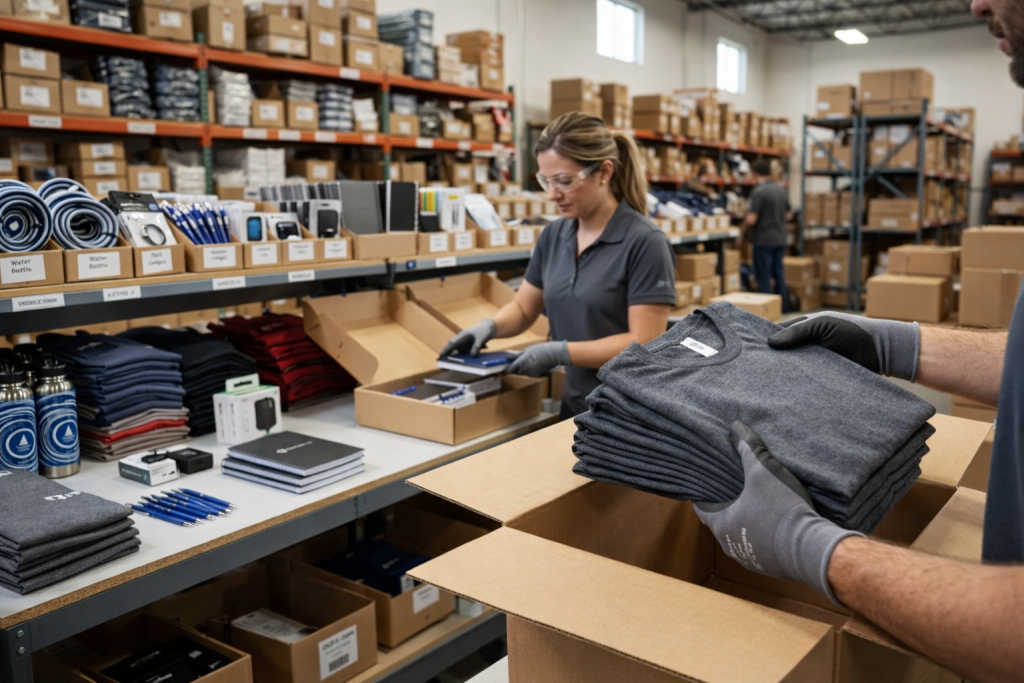
A corporate swag store is often misunderstood. To the average employee, it looks like a simple e-commerce website; a digital storefront where they click a button and a branded hoodie arrives. But to the operations, procurement, and marketing teams responsible for managing it, the storefront is merely the tip of the iceberg. The reality below the surface is a complex web of logistics, inventory management, and distribution logic.
If that infrastructure is weak, the “store” becomes a source of chaos: budget leakage, brand inconsistency, and logistical nightmares. If the infrastructure is strong, it becomes a strategic asset that drives culture and brand visibility.
The difference lies entirely in kitting and fulfillment services.
For mid-market and enterprise organizations, managing branded materials is no longer about buying products; it is about managing a supply chain. We are moving away from the era of the “swag closet” and into the era of the “branded merchandise infrastructure.” Below, we break down exactly how to build a scalable system that turns merchandise fulfillment from a headache into a high-performing operational engine.
What Is Kitting and Fulfillment in Corporate Merchandise?
To build a reliable system, we must first define the operational mechanics. “Fulfillment” in the context of corporate branding is distinct from standard B2C e-commerce fulfillment. It is not just about shipping a unit; it is about ensuring brand compliance and continuity across a distributed network.
Kitting is the process of assembling multiple individual SKUs (Stock Keeping Units) into a single, cohesive package ready for shipment. This transforms distinct items like a notebook, a pen, a welcome letter, and a hoodie into a unified “product” (e.g., a New Hire Welcome Kit).
Fulfillment encompasses the entire lifecycle of the physical asset:
- Warehousing: Secure storage of branded assets in a climate-controlled environment.
- Pick and Pack: Selecting the correct items from inventory and packaging them according to brand standards.
- Shipping & Logistics: Managing carriers, tracking, and international customs for global distribution.
The Distinction: Warehousing vs. Drop-Shipping vs. POD
It is critical to distinguish kitting and fulfillment services from other models:
- Drop-Shipping: The vendor buys from a manufacturer who ships directly to the end user. You have zero control over the packaging or the unboxing experience.
- Print-on-Demand (POD): Items are produced one at a time. While flexible, this model eliminates the ability to kit complex sets and often suffers from quality inconsistency.
- True Warehouse Kitting Service and Fulfillment: This is the infrastructure model. Inventory is produced in bulk (ensuring quality and lower unit costs), stored centrally, and deployed strategically.
This infrastructure is essential for:
- Employee Onboarding Kits: Ensuring every new hire, remote or on-site, receives the same premium welcome experience on day one.
- Sales Kits: Equipping distributed sales teams with physical collateral and product samples.
- Event Kit Fulfillment: Ensuring trade show booths and materials arrive at convention centers consolidated and on time.
- Recognition Programs: Delivering physical awards and gifts that reinforce culture.
When we talk about promotional product fulfillment, we are talking about the operational backbone that makes these programs repeatable and scalable.
Why Most Corporate Swag Stores Break at Scale
Most organizations launch a company store to “simplify” ordering. However, without a dedicated fulfillment strategy, the store often exacerbates the very problems it was meant to solve. According to NetSuite, supply chain fragmentation leads to a significant loss of visibility and control. In the context of branded merchandise, this manifests in five specific ways.
Overstocking and Stockouts
Without centralized visibility, departments guess at quantities. Marketing buys 5,000 pens that sit in a closet for three years, while HR runs out of onboarding hoodies the week a new acquisition is finalized. This inventory cycle ties up capital in dead stock and creates panic buying when assets are needed.
Fragmented Vendors
A typical organization might use one vendor for print, another for apparel, and a third for awards. This means three different warehouses (or office closets), three different shipping bills, and zero ability to kit items together. You cannot create a cohesive onboarding box if the water bottle is in Ohio and the notebook is in California.
Inconsistent Branding Across Locations
Distributed teams often go rogue. A regional sales manager might source their own shirts because the central store takes too long. This dilutes the brand, resulting in incorrect logo usage and varying quality standards across markets. Marq’s research notes that maintaining brand consistency can increase revenue by upwards of 20%, yet decentralized fulfillment makes this consistency nearly impossible to maintain.
No Centralized Inventory Visibility
When inventory is scattered across office supply closets and different vendor warehouses, nobody knows what the organization actually owns. There is no single “source of truth.” This leads to redundant spending, buying more journals because you didn’t know the Dallas office was sitting on 500 of them.
Budget Leakage and Shadow Ordering
Without a central fulfillment partner, “shadow ordering” runs rampant. Expenses are buried in credit card statements under vague categories like “Marketing – Misc,” making it impossible for Finance or Procurement to audit total category spend.
The corporate swag store breaks because it is treated as a shopping cart, not a logistics platform. To fix this, we must build the infrastructure first.
The Infrastructure Behind a Scalable Corporate Swag Store
A scalable store is built on the premise of one reliable system. This system requires physical infrastructure managed by professionals who understand the nuances of warehouse kitting service and fulfillment.
Warehousing for Branded Merchandise
Swag warehouse services for brand assets require more than just shelf space. It requires:
- Climate Control: Ensuring apparel doesn’t mildew and adhesives on tech products don’t degrade.
- SKU Standardization: assigning unique identifiers to every brand asset to prevent mix-ups (e.g., differentiating between a “Unisex Large” and “Ladies Medium”).
- Global Storage Considerations: For enterprise organizations, holding inventory in a single location may incur prohibitive shipping costs. A strategic partner evaluates where inventory should live to optimize distribution speed and cost.
Kitting for Multi-Location Distribution
Kitting is where the brand experience comes to life. A warehouse kitting service and fulfillment provider acts as the final quality control check before the brand touches the recipient’s hands.
- Event Kit Fulfillment: Instead of shipping 10 boxes of loose items to a trade show (hoping the booth staff arranges them correctly), the warehouse kits the exact quantity needed for that specific event, labels it clearly, and ensures return logistics are handled.
- Franchise/Dealer Launch Kits: When opening a new location, the “Store in a Box” concept ensures the new branch has every piece of signage, uniform, and collateral needed to operate on Day 1.
- Sales Rep Launch Kits: Equipping a distributed sales team requires precision. Instead of reps sourcing their own materials, a centralized system bundles their branded apparel, product samples, and sales collateral into one package, shipping it directly to their home or regional office so they are field-ready immediately.
- Onboarding Welcome Kits: The employee experience must scale. For remote or distributed teams, a standardized onboarding kit guarantees that every new hire, whether in London or Chicago, receives the exact same premium introduction to the brand’s culture on their first day without creating manual packing work for HR.
Global Distribution and Multi-Location Fulfillment
Shipping a t-shirt from Chicago to London is easy. Getting 500 employee appreciation gifts through customs in Brazil or India without them getting stuck or taxed exorbitantly is difficult. Scalable infrastructure requires a partner who understands:
- Customs & Duties: Pre-clearing shipments to ensure the recipient isn’t asked to pay taxes on a gift.
- Bulk vs. On-Demand: Knowing when to ship pallets to a regional hub versus individual parcels to remote employees.
Inventory Control Without Retail SaaS Complexity
There is a temptation to use retail inventory software (like Shopify or NetSuite) for internal swag. However, corporate needs are different. You aren’t maximizing profit margin per SKU; you are maximizing internal adoption and budget efficiency. The infrastructure must allow for:
- Cost Center Allocation: Charging a specific shipment to “Marketing – Northeast Region” rather than a credit card.
- User Quotas: Allowing an employee to order $50 worth of gear, but not $500. This is corporate merchandise inventory, not retail POS.
Corporate Swag Store vs Marketplace vs Decentralized Ordering
To understand why a dedicated fulfillment partner is necessary, we can compare the three most common models organizations use.
| Feature | Corporate Swag Store + Fulfillment | Marketplace Platform | Decentralized Ordering |
| Brand Control | High. Strict governance on what is produced and stocked. | Medium. Restricted to platform options. | Low. Rogue spending and logo misuse are common. |
| Vendor Consolidation | Unified. One partner for print, apparel, and kitting. | Partial. Often outsources to third parties behind the scenes. | None. Multiple vendors, multiple invoices. |
| Inventory Visibility | Total. Real-time view of all assets across the network. | Limited. Visibility only into what is bought through them. | Zero. No central record of assets. |
| Budget Governance | Centralized. Cost codes, quotas, and approval workflows. | Transactional. Credit card focus. | Chaotic. Hidden spend across departments. |
| Kitting Capability | Custom. Complex, multi-item kits with custom packaging. | Standardized. Limited to basic boxes. | Manual. Your marketing team is stuffing boxes in a conference room. |
| Scalability | High. Built for enterprise complexity. | Medium. Good for simple needs. | None. Breaks immediately with growth. |
The Corporate Swag Fulfillment model is the only one that functions as a true system of record.
How to Design a Scalable Swag Store and Fulfillment System
Designing this system requires an operational mindset. We do not start with “what products do we want?” We start with “how does the product move?”
1. Consolidate Vendors
Stop buying pens from one vendor and shirts from another. To enable branded merchandise fulfillment that is efficient, you need a single partner who can intake, store, and kit all asset types. This aligns with a broader vendor consolidation strategy.
2. Standardize SKUs
Treat your brand assets like retail products. Establish a naming convention. Decide on the core items that must always be in stock (e.g., the “Core Collection”) versus seasonal rotation. This standardization is the prerequisite for automation.
3. Centralize Warehousing
Move inventory out of office closets and into a professional facility. This shifts the liability of storage (theft, damage, obsolescence) to swag fulfillment companies equipped to handle it.
4. Implement Kitting Workflows
Define your standard kits.
- The New Hire Kit: Hoodie + Notebook + Pen + Welcome Card.
- The Client Gift: Premium Jacket + Tech Accessory.
By defining these as virtual SKUs in the system, ordering becomes a one-click merchandise fulfillment process rather than a pick-list exercise.
5. Set Distribution Permissions
Not everyone needs access to everything. A scalable system sets tiers:
- General Employees: Can access the “Company Store” for personal purchase or stipend use.
- HR Managers: Can trigger “Onboarding Kits.”
- Event Managers: Can access “Trade Show Assets” (tablecloths, banners).
6. Integrate Reporting and Budget Controls
The system must talk to Finance. Monthly reporting should show usage by department, inventory turnover rates, and total landed costs (product + promotional products fulfillment services + shipping).
Managing Inventory Across Events, Employees, and Partners
Operational depth means handling complex scenarios. A static inventory list isn’t enough; you need active management.
Access Tiers: We recommend structuring your fulfillment interface to match your org chart. Field marketing teams need access to event collateral that an engineer in R&D never needs to see. Your infrastructure partner should be able to segment the catalog view based on user login, ensuring that expensive assets (like premium client gifts) are reserved for authorized budget holders.
Event-Based Temporary Stores: For large conferences, you don’t want to drain your general stock. A robust system allows you to launch event-based temporary stores—digital pop-ups where stock is physically or virtually allocated for a specific campaign. This ensures that when the Sales VP goes to grab 500 hats for the annual summit, they are actually available, not depleted by day-to-day corporate orders.
Approval Workflows: To prevent budget leakage, the fulfillment system must enforce governance before an item is ever picked from a shelf. By implementing automated approval workflows, high-value orders or requests that exceed a user’s quota are automatically routed to the appropriate manager or department head. This keeps spend strictly controlled without creating manual bottlenecks.
Regional Inventory Allocation: Shipping everything from a single central hub is rarely cost-effective for a truly distributed workforce. Scalable systems allow for regional inventory allocation. By analyzing usage data, your fulfillment partner can position high-turnover assets in regional warehouses closer to your largest employee or partner hubs, drastically reducing transit times and shipping costs.
Forecasting for Seasonal Campaigns: Promotional product fulfillment is inherently seasonal. A strategic partner reviews burn rates with you quarterly, providing data-driven forecasting to advise on when to replenish stock. This proactive approach avoids rush production fees, expensive air freight, and empty shelves when demand is highest.
When to Use Kitting vs. On-Demand Production
While we advocate for warehousing core items, a hybrid model is often the smartest financial move.
Use Warehousing & Kitting When:
- The Unboxing Experience Matters: For onboarding or high-value client gifting, the presentation (crinkle paper, custom box, tissue) is part of the brand equity.
- Speed is Critical: Pick-and-pack from a warehouse takes 24-48 hours. On-demand production can take 7-14 days. If you need it “now,” it must be on the shelf.
- High Volume/Low Cost: It is not cost-effective to print 10,000 pens on demand. Bulk production lowers the unit cost significantly, offsetting the storage fees.
Use Print On-Demand (POD) When:
- Sizing is Variable: For employee apparel stores where you can’t predict size breakdowns, POD prevents you from getting stuck with 50 XS t-shirts nobody wants.
- Testing New Designs: Before committing to 500 units, offer a design on-demand to gauge interest.
- Personalization: If every item needs a unique name (e.g., a jersey), it must be produced to order.
The ideal corporate swag store fulfillment system integrates both: a warehoused “Core Collection” for kits and immediate needs, and an “Extended Catalog” produced on-demand to offer variety without inventory risk.
Choosing the Right Kitting and Fulfillment Partner
Not all swag fulfillment companies are created equal. Many are simply promotional product distributors who outsource the shipping to third parties, adding layers of markup and losing control over the process.
When evaluating a partner for your infrastructure, ask these questions:
- Do you own the warehouse? Or are you relying on a 3PL (Third Party Logistics) provider? Direct ownership implies tighter quality control.
- Can you handle custom kitting? Ask for examples of complex kits they have assembled. If they only do standard brown boxes, they aren’t a brand partner.
- How do you handle multi-location distribution? Ask about their capabilities for splitting shipments across 50 branch locations simultaneously.
- What is your reporting capability? Can they provide a real-time view of inventory levels, low-stock alerts, and departmental spend?
- Do you support inventory governance? Can they implement approval workflows so that orders over a certain dollar amount require manager sign-off?
We believe that your partner should act as an extension of your operations team, not just a vendor who sells you mugs.
Assessing Your Corporate Swag Store Infrastructure
If your current process involves Marketing Managers packing boxes in a conference room, or Finance chasing down receipts from five different vendors, your infrastructure is not scalable.
The goal of kitting and fulfillment services is to make the physical movement of your brand invisible to your internal teams. HR should click “Onboard,” and the kit should arrive. Sales should click “Ship,” and the event materials should appear.
To get there, you need to assess your current model:
- Vendor Fragmentation Analysis: How many different invoices are you processing for brand materials?
- Inventory Risk Assessment: Do you know exactly how much inventory you own and where it is right now?
- Budget Leakage Review: How much is being spent on rush shipping and one-off orders due to poor planning?
- Fulfillment Capability Evaluation: Are your current vendors equipped to handle complex kitting, multi-location distribution, and robust inventory governance, or are they just printing logos and shipping boxes?
Building a scalable branded merchandise infrastructure is the only way to move from transactional chaos to operational control. It ensures that as your organization grows, your brand remains consistent, your budget remains managed, and your people remain engaged.
Now it’s your turn. Evaluate whether your current store and fulfillment model can scale.