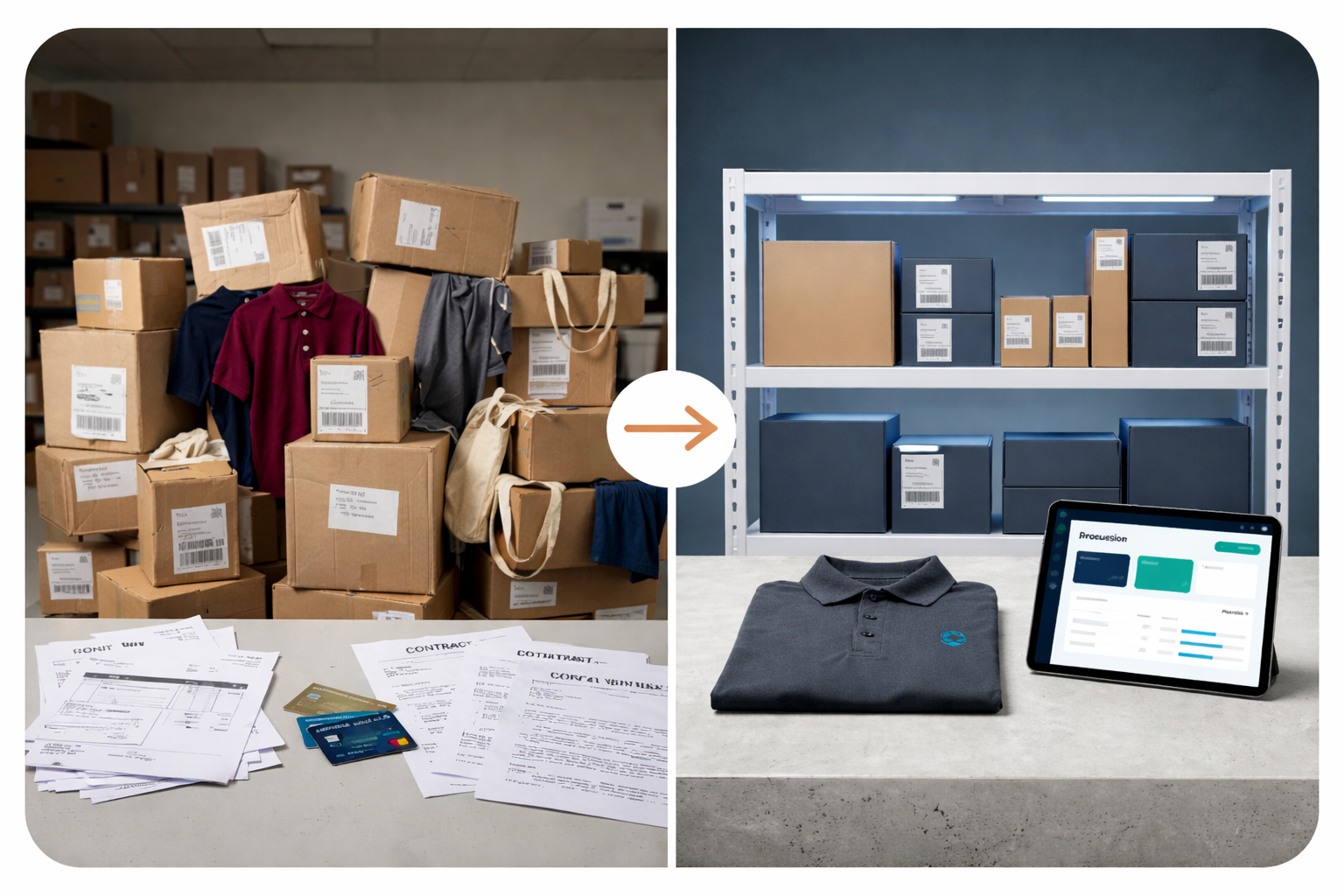
What Maverick Spend Really Costs Organizations Across Multiple Offices

Maverick spend is often described simply as a procurement compliance issue. When employees or departments bypass established protocols to make purchases on their own, it is easy to view the problem as a lack of purchasing discipline.

But for organizations operating across multiple offices, departments, and teams, it represents something much larger: a fundamental breakdown in operational coordination.

When employees or departments purchase from vendors outside established procurement systems, organizations immediately lose visibility into vendor relationships, pricing consistency, purchasing volumes, contract agreements, and overall operational efficiency.

While individual, decentralized transactions may appear minor, like a regional manager ordering a batch of branded apparel for a local event, or an HR director sourcing new employee welcome kits, this decentralized purchasing creates compounding operational costs across an organization. These hidden costs include duplicate vendor relationships, highly inconsistent pricing, massive administrative overhead, contract fragmentation, and severely reduced negotiating leverage.

Many organizations assume these problems can be fixed with stricter policies. In reality, they are infrastructure problems. Without systems that actively coordinate vendor sourcing, procurement governance, and purchasing visibility, decentralized spending becomes virtually impossible to control. To fix it, we have to look at the systems driving the behavior.

What Maverick Spend Actually Means in Procurement

If you ask a finance leader, “what is maverick spend?”, they will likely point to the ledger. However, the maverick spend definition refers to purchases made outside an organization’s approved procurement processes or vendor agreements.

Also commonly referred to as rogue spend, these transactions typically occur when well-meaning employees or departments bypass negotiated contracts, purchase from unapproved vendors, or source products entirely independent of the procurement team’s oversight.

We see this frequently in distributed organizations. Examples include different marketing departments ordering from entirely different promotional vendors, regional offices sourcing suppliers locally for their specific branch, or field teams completely bypassing centralized purchasing systems because they feel the existing process is too slow.

Organizations often underestimate the true impact of this behavior because individual transactions appear small. A thousand dollars here or a few hundred there rarely raises immediate red flags. However, research shows that organizations lose as much as 16% of their negotiated savings to maverick spending.

Maverick spend rarely appears significant at the transaction level, but its operational impact compounds drastically across large, multi-location organizations.

Why Maverick Spend Happens Inside Organizations

To eliminate maverick spending, we first have to understand why it occurs. In our experience, it often emerges when procurement systems do not match how organizations actually operate on the ground.

Most instances of decentralized purchasing are not malicious. They are workarounds. Common structural causes include slow procurement approval processes, a lack of approved vendor catalogs that are easy to access, limited purchasing visibility across departments, and a high degree of regional autonomy across satellite offices.

Departments often source vendors independently simply to solve immediate operational needs. If an internal system takes three weeks to approve a purchase, a team leader will find a local vendor who can deliver in three days. Examples include marketing teams ordering merchandise for time-sensitive campaigns, HR teams sourcing onboarding materials for an unexpectedly large hiring cohort, or regional offices purchasing locally for branch events.

When you look at the root cause, unauthorized purchasing is rarely an act of rebellion. Maverick spend often reflects operational gaps rather than intentional policy violations. If the system is too difficult to use, your people will find a different way to get their jobs done.

The Hidden Costs of Maverick Spend

While unauthorized purchases may appear minor individually, they generate significant hidden costs across an organization. Because these purchases bypass procurement oversight, they bypass the safeguards designed to protect the company’s bottom line and brand consistency.

These costs go far beyond the invoice price. They include duplicate vendor relationships, where multiple departments unknowingly pay different rates to the same supplier, or worse, use entirely different suppliers for the exact same products. This leads to inconsistent pricing, increased administrative workload for finance teams trying to reconcile fragmented invoices, and contract fragmentation. Ultimately, it results in reduced supplier leverage; if your company’s spending power is split across fifty vendors instead of five, you lose the ability to negotiate enterprise-level pricing.

As a result, organizations experience multiple vendors supplying identical products, uncontrolled departmental purchasing, and incredibly limited procurement visibility. According to Deloitte’s 2025 Global Chief Procurement Officer Survey, 64% of procurement leaders prioritize enabling greater visibility into their supply chain to mitigate risks, yet uncontrolled departmental purchasing makes this nearly impossible. 

The key insight for enterprise leaders is this: maverick spend rarely appears clearly in financial reporting, but it steadily and aggressively erodes operational efficiency.

Where Maverick Spend Appears Across Operational Programs

Maverick spend frequently emerges inside everyday operational programs that rely on consistent vendor sourcing and merchandise distribution. These are the programs that keep your culture alive and your brand visible.

These initiatives often involve multiple departments and locations. Without coordinated systems, each team may independently select vendors, resulting in a chaotic brand ecosystem.

Employee Onboarding Programs

HR teams often manage onboarding kits that include welcome gifts, branded apparel, printed materials, and equipment packages. When offices or departments assemble these kits independently, organizations may unknowingly source products from a dozen multiple vendors. This leads to heavily fragmented purchasing and inconsistent employee experiences. An employee hired in Chicago should receive the exact same high-quality welcome experience as an employee hired in London. Without a system, they won’t.

Employee Recognition Programs

Recognition programs frequently require awards, incentive products, gift packages, and milestone recognition kits. Employee Recognition Infrastructure is critical here. If departments source these items independently, organizations may develop multiple vendor relationships for very similar products. This creates massive procurement complexity and inconsistent reward experiences, heavily diluting the impact of the recognition itself.

Branded Merchandise Programs

Marketing teams regularly purchase branded materials for events, campaigns, client gifts, and internal initiatives. When Branded Merchandise Fulfillment Infrastructure is lacking, different offices may order similar products from different suppliers. This not only contributes to vendor sprawl and inconsistent pricing but also creates severe brand consistency risks.

Event and Field Team Kits

Sales teams, field teams, and regional offices often require merchandise or materials for events and programs, including conference merchandise kits, sales enablement kits, and promotional product packages. When these teams source vendors independently to meet tight event deadlines, organizations lose all visibility into purchasing activity, and the brand’s representation in the field is left entirely to chance.

Why Maverick Spend Increases Across Multiple Offices and Teams

Organizations operating across multiple offices face significantly steeper challenges in controlling costs. In these environments, purchasing authority becomes distributed across regional offices, department leaders, local managers, and field teams.

Without a coordinated vendor infrastructure in place, each team may independently source suppliers to solve their immediate needs, scaling the inefficiencies.

Vendor Sprawl

Independent purchasing decisions almost always lead to vendor duplication. Different teams may select different suppliers for identical products simply because they don’t know an existing corporate relationship exists. This vendor sprawl and supplier fragmentation rapidly reduce negotiating leverage and vastly increase vendor management complexity for your accounts payable team. Establishing a cohesive vendor management strategy is the only way to reverse this trend.

Inconsistent Purchasing Standards

When departments buy independently, they purchase products that differ wildly in quality, pricing, and branding. A local branch might order a batch of branded apparel that uses the wrong logo colors or cheap, flimsy materials that damage the brand’s premium perception. These inconsistencies create operational friction across the entire organization and weaken the brand’s impact.

Limited Procurement Visibility

When purchases occur completely outside procurement systems, organizations struggle to track vendor usage, spending patterns, and contract compliance. Without robust procurement governance and continuous procurement oversight, leadership remains blind to where company capital is actually flowing. Without visibility, procurement leaders cannot effectively manage vendor relationships or strategize for long-term growth.

The Operational Infrastructure That Reduces Maverick Spend

Organizations that successfully control maverick spend do not simply write stricter rulebooks. They implement intelligent systems that actively coordinate vendor sourcing across all departments and offices.

Centralized Vendor Management

To regain control, organizations often establish approved vendor networks. These systems help standardize supplier relationships, maintain negotiated pricing agreements, and drastically reduce vendor duplication. By deploying a centralized supplier management strategy, multi-location procurement management transforms from a chaotic guessing game into a streamlined vendor management strategy.

Procurement Governance

Effective procurement governance frameworks establish clear, easy-to-follow purchasing policies and streamlined vendor approval processes. As noted by Gartner, organizations must differentiate tactical, planned sourcing from truly unmanaged spend to maintain agility without compromising compliance. When designed correctly, these systems do not slow teams down; they empower them to buy what they need quickly from pre-vetted sources. This improves procurement oversight, guarantees contract compliance, and provides total spending visibility.

Vendor Consolidation

Reducing the overall number of suppliers simplifies the entire procurement lifecycle. Strategic vendor consolidation helps organizations strengthen their most valuable supplier relationships, dramatically increase negotiating leverage, and improve purchasing visibility. How vendor consolidation reduces operational costs across multiple offices is a topic we discuss often, precisely because it is one of the fastest paths to true operational cost control and procurement efficiency.

Early Signs Maverick Spend Is Becoming a Serious Problem

How do you know if your organization has a rogue spend issue? Organizations experiencing maverick spend may observe multiple departments purchasing from completely different vendors for the exact same marketing tools. They will notice difficulty tracking supplier relationships, highly inconsistent product pricing across departments, fragmented vendor contracts, and limited procurement visibility.

Behind the scenes, finance teams may struggle to understand total vendor spending, supplier usage patterns, or contract compliance levels.

The key insight is simple: when organizations cannot clearly track where purchasing occurs, decentralized purchasing is likely already widespread. If your finance team has to ask a department head who provided the apparel for last week’s trade show, the system is broken.

Why Controlling Maverick Spend Requires Operational Systems

Organizations often attempt to control maverick spend through top-down purchasing policies alone. However, policies are rarely effective without the operational systems required to execute them easily. If a policy makes an employee’s job harder, they will circumvent it.

Effective procurement systems typically include curated, approved vendor catalogs, centralized supplier sourcing hubs, clear procurement governance frameworks, real-time purchasing visibility tools, and seamless vendor coordination across departments. These systems allow organizations to manage procurement consistently across multiple offices and teams, ensuring that doing the right thing is also the easiest thing.

Organizations that reduce maverick spend successfully treat procurement as a connected operational system, not simply a set of rigid purchasing rules.

Conclusion

Maverick spend is often described simply as unauthorized purchasing. But for organizations operating across multiple offices and departments, it represents something much larger. It signals a critical breakdown in the systems that coordinate vendor relationships and purchasing activity.

When teams purchase independently, organizations lose visibility into vendor relationships, contract compliance, pricing consistency, and overall operational efficiency. Over time, decentralized purchasing creates vendor sprawl, highly fragmented supplier relationships, and continuously rising operational costs.

Organizations that successfully reduce maverick spend do so by intentionally strengthening their procurement infrastructure. By actively coordinating vendor sourcing, enforcing procurement governance, and demanding purchasing visibility, companies regain control over supplier relationships and restore true operational efficiency.

Evaluate Your Vendor Infrastructure

If your organization works with multiple vendors across departments, offices, or teams, it may be time to evaluate whether your vendor management and procurement systems are designed to support operational scale.

Talk to a Vendor Infrastructure Expert

What Are Kitting and Fulfillment Services — and Why Multi-Location Brands Need Them

Kitting and fulfillment services are often discussed as warehouse logistics functions. But for organizations operating across multiple offices, teams, and regions, these services support something much larger: the operational infrastructure behind branded merchandise programs.

Many companies assume that managing onboarding kits, event merchandise, employee swag, or field team kits is simply a procurement task. Someone in HR or Marketing orders the items, they arrive in boxes, and they get handed out. In reality, as your company grows, these programs rely on coordinated systems that manage inventory, assembly, vendor sourcing, fulfillment logistics, and distribution across locations.

Without operational infrastructure, merchandise programs become fragmented, inconsistent, and incredibly difficult to scale. When brand and culture initiatives break down, it is rarely because of a lack of ideas; it is because the logistics behind them failed. Let’s look at what kitting and fulfillment services actually entail, and why distributed organizations must treat them as critical business infrastructure.

What Kitting and Fulfillment Services Actually Do

To understand the value of these operations, we first have to define what they mean. Kitting refers to the process of assembling multiple individual products into a single packaged unit. Rather than shipping a t-shirt, a notebook, and a pen separately, those items are gathered, packaged together in a branded box, and shipped as a cohesive experience.

Examples of this process include:

  • Onboarding kits
  • Event merchandise kits
  • Sales enablement kits
  • Product launch packages
  • Employee recognition kits

Fulfillment services then manage the operational process that happens after the kit is defined. This includes inventory storage, kit assembly, order processing, and the final distribution to recipients. Whether you are utilizing internal teams or partnering with third-party warehouse kitting services, the core function remains the same: taking raw merchandise and turning it into a deliverable asset.

When managing large volumes of merchandise or product bundles, organizations quickly realize that the kitting process in warehouse environments is highly detailed. Every box must be packed precisely, using correct sizes, correct items, and correct branding. A reliable product kitting services partner simplifies complex product distribution by assembling items before they are shipped, ensuring the end user receives exactly what was intended.

Why Companies Use Kitting Services

Organizations use kitting and fulfillment services to streamline distribution and reduce operational complexity. As companies grow, they no longer have the time or physical space to store boxes of apparel and manually pack them in a back office.

Common use cases include:

  • Employee onboarding kits
  • Conference and event merchandise
  • Field sales kits
  • Product launch packages
  • Corporate swag distribution

These kits often contain multiple items that must be packaged together before distribution, such as branded apparel, printed materials, product samples, and welcome gifts.

The primary operational motivation here is consistency. According to Gallup data, strong engagement experiences are directly tied to employee retention, with poorly structured onboarding leading to early turnover. When a new hire starts, their welcome package is often their first physical touchpoint with your brand’s culture. If the kitting logistics are dialed in, they receive a professional, thoughtfully assembled package on day one. If the fulfillment operations fail, they receive a wrong-sized shirt three weeks late. Kitting helps ensure each recipient receives a complete and consistent package, every single time.

The Operational Complexity Behind Kitting Programs

While the concept of assembling kits may appear simple on the surface, large organizations quickly encounter operational complexity. Once you move past ordering a single batch of pens, kitting operations must coordinate inventory management, vendor sourcing, product assembly, quality control, and distribution logistics.

This complexity multiplies because these programs rarely live in just one department. The departments often involved include:

  • Marketing (ensuring brand compliance)
  • Procurement (negotiating costs and managing vendors)
  • Operations (handling physical logistics)
  • HR (initiating orders for onboarding or recognition)
  • Finance (tracking and attributing spend)

As programs grow, manual coordination across these departments becomes difficult to sustain. Marketing is ordering the boxes, Procurement is sourcing the apparel, and HR is trying to figure out who is actually shipping them. Kitting fulfillment programs often become operational challenges before organizations realize they are infrastructure challenges.

Why Kitting Becomes Difficult Across Multiple Offices and Teams

Organizations operating across multiple offices face additional challenges when managing merchandise distribution. It is one thing to hand a welcome kit to an employee walking into your headquarters; it is an entirely different challenge when kits may need to be delivered to regional offices, remote employees, international teams, or field sales teams.

When you scale without a central system, several specific operational breakdowns occur.

Inconsistent Kit Experiences

Without a central system, different departments or offices may assemble kits independently. The Chicago office might order high-end jackets, while the Dallas office orders generic, low-budget fleeces. This can result in different merchandise selections, inconsistent branding, and varying product quality.

When employees in different locations receive completely different experiences, it undermines brand consistency and creates cultural friction. If you want to maintain brand consistency across offices, you cannot allow regional managers to source and build their own kits off-brand.

Uncoordinated Vendor Relationships

When departments operate in silos, they often source merchandise from separate vendors. A marketing team might use one supplier for print, an HR team uses another for apparel, and a sales team uses a third for event giveaways.

The results include multiple suppliers, inconsistent pricing, duplicate SKUs, and limited purchasing leverage. This fragmentation increases procurement complexity drastically. In fact, reducing supply chain complexity through strict vendor consolidation is now a priority for enterprise leaders. Vendor consolidation is the only way to solve merchandise sourcing fragmentation. By channeling your spend through a single partner, you regain control over quality and budget.

Distribution Delays and Fulfillment Breakdowns

Kits often need to be delivered at specific moments. A new hire’s first day of employment, a major event registration, or a global product launch announcement all have hard deadlines.

When fulfillment logistics are not coordinated, deliveries arrive late or incomplete. Relying on an office manager to manually pack and ship 50 boxes via FedEx is not a scalable merchandise fulfillment logistics strategy. Multi-location merchandise distribution requires a dedicated system that can route orders, verify addresses, and guarantee delivery dates across the country.

The Hidden Infrastructure Behind Kitting and Fulfillment

Many organizations treat kitting as a warehouse task, only wanting to know where the boxes are stored. In reality, successful kitting programs depend on operational systems. At Inch Creative, we view kitting and fulfillment services not just as a physical action, but as the technology and governance required to protect your brand.

Inventory Visibility

Kitting programs require accurate inventory tracking. If you are building a kit with five different components, running out of just one item halts the entire process. Without inventory visibility, organizations experience stockouts, over-ordering, and duplicate inventory.

A lack of visibility is a massive liability; fractured data and disparate systems prevent companies from seeing their true inventory risk. Proper inventory visibility ensures that kits can be assembled consistently and delivered on time, because you always know exactly what you have on hand. 

Vendor Coordination

Kitting operations often involve multiple product suppliers; one for the custom box, one for the drinkware, one for the apparel, and one for the printed inserts. Without centralized vendor coordination, organizations experience fragmented purchasing, inconsistent product quality, and uncontrolled spending.

Vendor consolidation simplifies procurement and improves operational control. When you bring all of these sourcing streams under one reliable system, you eliminate the administrative burden of chasing down a dozen different invoices every month.

Fulfillment and Distribution Systems

Kitting operations improve when companies implement structured fulfillment systems. You cannot run a national program off a spreadsheet. These systems help manage inventory storage, fulfillment assembly services, kit assembly workflows, order processing, and shipment tracking.

A robust fulfillment infrastructure allows an HR leader in New York to click a button and know that a perfectly branded kit is automatically being assembled and shipped to a new remote hire in California. That is the standard for modern corporate merchandise programs.

Early Signs Your Kitting Program Is Becoming Difficult to Manage

How do you know when you have outgrown your current process? If you are relying on manual workarounds, your system is likely already straining. Early diagnostic signs include:

  • Employees receiving inconsistent kits based on their location or department
  • Frequent stockouts of key sizes or items
  • Merchandise being ordered by multiple departments without communication
  • Shipping delays causing missed onboarding days or event deadlines
  • A complete lack of inventory visibility

Beyond the physical logistics, organizations may also struggle with tracking spending across vendors, maintaining brand consistency across regions, and scaling distribution across new offices.

The key insight is this: programs without operational infrastructure eventually become difficult to control. What starts as an inconvenience as small as something like a few missing t-shirts eventually balloons into a massive hidden cost of wasted spend and damaged brand equity. 

Why Scalable Merchandise Programs Require Operational Infrastructure

Companies that successfully scale merchandise programs treat kitting and fulfillment as infrastructure systems. They do not view it as a one-off purchase; they view it as an ongoing operational capability.

Effective systems typically include:

  • Centralized merchandise sourcing
  • Controlled product catalogs
  • Inventory management systems
  • Structured fulfillment workflows
  • Vendor coordination

These systems support consistent brand experiences, efficient distribution, and complete operational visibility. When you build the right foundation, branded merchandise operations stop being a headache and start being a strategic asset. If you are preparing to expand, understanding how to navigate multi-location merchandise distribution is essential. 

Conclusion

Kitting and fulfillment services are often viewed as warehouse logistics processes. But for organizations operating across multiple offices and teams, they serve a much larger role. These services support the operational infrastructure required to assemble, manage, and distribute merchandise programs at scale.

Without systems for inventory visibility, vendor coordination, kit assembly, and fulfillment logistics, merchandise programs become fragmented and difficult to sustain. Organizations that scale branded merchandise successfully treat kitting and fulfillment as operational infrastructure, not just packaging tasks.

If your company wants to stop wasting time managing multiple vendors and inconsistent inventory, it is time to upgrade the system that powers your brand.

Evaluate Your Merchandise Fulfillment Infrastructure

If your organization distributes onboarding kits, event merchandise, or branded products across multiple offices, it may be time to evaluate whether the sourcing and fulfillment systems behind those programs are designed to scale. Kitting and fulfillment services become essential when organizations begin managing merchandise across multiple teams, vendors, and locations. Without centralized systems for sourcing, assembly, and distribution, these programs quickly become operationally complex. Companies operating across multiple offices must ensure the infrastructure behind their merchandise programs is built to scale.

Talk to a Merchandise Infrastructure Expert

Why Employee Recognition Programs Fail Across Multiple Offices and Teams

Recent data from Gallup reveals that U.S. employee engagement has dropped to a ten-year low, prompting organizations to invest heavily in retention strategies. But despite good intentions, many of these initiatives fall flat. The hard truth is that employee recognition programs rarely fail because an organization doesn’t value its people. They fail because execution breaks down operationally.

Most companies can easily design a compelling recognition strategy in a boardroom. They understand the “why” behind appreciating their workforce. However, they drastically underestimate the complex infrastructure required to deliver consistent recognition across multiple offices, remote teams, and global locations.

When you strip away the celebratory messaging, recognizing employees at scale is fundamentally a supply chain and logistics challenge. Without a centralized system to govern the sourcing, fulfillment, and tracking of apparel, print, and branded materials, these programs quickly become decentralized, expensive, and chaotic.

Why Employee Recognition Programs Often Start Strong — Then Stall

Most employee recognition programs launch with strong enthusiasm and executive alignment. The typical lifecycle of these initiatives begins with a clear set of corporate goals. Leadership teams aim to improve engagement, reinforce company culture, consistently reward employee performance, and strengthen long-term retention.

During the rollout phase, excitement is high. However, employee rewards and recognition programs often hit a wall within the first six to twelve months. Why? Because early momentum fades the moment operational complexity appears.

HR leaders who designed the initiative suddenly find themselves bogged down: ordering branded jackets, tracking down lost shipments, or trying to reconcile invoices from a dozen different local vendors. They quickly discover that staff recognition initiatives are easy to conceptualize but incredibly difficult to execute.

So while launching employee incentive programs requires a solid strategy, sustaining them requires a reliable operational system. When that system is absent, the program stalls.

The Operational Challenges That Undermine Recognition Programs

To understand why employee recognition programs fail, we have to look past the HR department. True recognition requires seamless coordination across HR, Procurement, Marketing, Finance, and Operations. When these departments operate in silos, the entire program suffers.

Common breakdown points appear quickly. Organizations experience recognition program participation problems because managers find the ordering process too cumbersome. According to Gartner, 75% of HR leaders report their managers are already overwhelmed by the expansion of their daily responsibilities. Adding manual recognition tasks like expensing gifts or sourcing local vendors only exacerbates this process hurdle.

This administrative overload leads to delayed rewards, inconsistent recognition experiences, and budget overruns. Furthermore, because data is trapped in fragmented systems or manager credit card statements, tracking employee recognition metrics or proving recognition program ROI becomes virtually impossible.

The reality is clear: most employee recognition program challenges are not cultural failures; they are infrastructure failures.

Why Recognition Breaks Across Multiple Offices and Teams

Organizations operating across multiple locations face an exponentially higher degree of difficulty. Recognition programs must work flawlessly across regional offices, remote employees, field teams, and international sites. When a company lacks a unified system of record for branded demand, the employee experience fractures along geographical lines.

Inconsistent Recognition Experiences

When there is no central governance, local teams are forced to select different rewards or rely on separate local vendors. As a result, employees in different offices receive entirely different experiences for the exact same milestone. An employee celebrating a fifth work anniversary in the Chicago office might receive a high-quality, retail-grade branded jacket, while their counterpart in the London office receives a generic gift card and a cheap mug. This lack of employee recognition consistency breeds resentment and severely weakens the program’s credibility across the organization.

Uncoordinated Vendor Relationships

Decentralization inevitably leads to uncoordinated vendor relationships. When regional managers or different departments independently source recognition items, the result is chaos. Marketing might use one vendor for onboarding kits, while HR uses three different suppliers for performance awards. This results in inconsistent merchandise quality, wildly varying pricing, and fragmented vendor management that makes true brand governance impossible.

Delayed Recognition Moments

Recognition is a time-sensitive psychological event. Its impact is severely diminished when the reward arrives weeks or months after the milestone. When managers have to manually handle employee rewards logistics, such as individually packing and shipping items to remote workers, delays are guaranteed. Without an automated system for employee rewards fulfillment, the moment of appreciation is replaced by administrative friction.

The Hidden Infrastructure Behind Recognition Programs

When we look under the hood of a functioning employee engagement program, the sheer volume of operational touchpoints is staggering. A standard program often includes milestone awards, anniversary gifts, new hire onboarding kits, performance rewards, and ongoing access to branded merchandise. Each of these categories requires rigid operational coordination.

Budget Leakage and Uncontrolled Spending

Without a centralized system, employee rewards budget management is a guessing game. Decentralized ordering leads to uncontrolled purchasing across the organization. Managers expense items on corporate cards, duplicate vendors are onboarded across different regions, and hidden shipping costs eat into the actual value of the rewards. This budget leakage means companies are spending more money on administrative waste than on the actual employees they are trying to recognize.

Fulfillment and Distribution Complexity

Shipping a single branded hoodie to one employee is easy. Doing it for thousands of employees across the country, or the globe, is a logistical nightmare. The complexities of employee incentive fulfillment include navigating shipping delays, managing inventory shortages, and dealing with international customs. Furthermore, global reward distribution involves navigating the tax implications for international rewards. If an organization does not have a dedicated partner to handle employee rewards logistics, HR teams are forced to become amateur supply chain managers.

Vendor Fragmentation

Operating with multiple suppliers prevents organizations from leveraging their true buying power. Vendor fragmentation means a lack of negotiated pricing, limited visibility into total enterprise spending, and extreme difficulty in maintaining brand consistency. Consolidating this spend isn’t just an HR priority; it requires deep procurement alignment. A single system of record solves this by unifying apparel, print, and branded materials under one strategic umbrella.

Why Recognition Programs Need Operational Infrastructure

Successful employee recognition programs rely on structured systems that support execution. Recent research on High-Impact Rewards from Deloitte shows that mature organizations with centralized, strategic approaches to rewards are three times more likely to optimize their return on investment compared to organizations using siloed, transactional setups. To scale effectively, you need infrastructure.

Centralized Reward Sourcing

The foundation of a reliable system is centralized reward sourcing. By utilizing approved vendors and a standardized procurement process, organizations guarantee a consistent employee experience regardless of location. Centralization also provides absolute brand control. Marketing and Brand teams no longer have to worry about low-quality, off-brand merchandise diluting their identity in the field, because every item is sourced through a single, governed pipeline.

Controlled Recognition Catalogs

To prevent rogue purchasing and standardise the quality of awards, organizations must implement controlled, internal catalogs of approved rewards. These curated portals simplify the ordering process for managers while strictly enforcing budget limits. Rather than scrolling through endless promotional product websites, managers can select from a pre-approved, high-quality catalog that aligns with corporate standards.

Fulfillment and Tracking Systems

Employee recognition program tracking fundamentally improves when companies implement dedicated fulfillment technology. This includes automated approval workflows, hard budget controls, and real-time inventory visibility. With tracking dashboards in place, HR and Finance teams finally have access to accurate employee recognition metrics. They can see exactly who is being recognized, what is being spent, and how quickly rewards are being delivered.

The Early Warning Signs Your Recognition Program Is Breaking Down

How do you know if your current recognition program ROI is falling short? The warning signs are usually operational before they become cultural.

Look for persistently low participation rates among managers. If they aren’t utilizing the program, it is likely because the process is too difficult. Pay attention to recognition delays; if employees are receiving anniversary awards weeks after the fact, the logistics are broken. Furthermore, if you are seeing inconsistent reward quality across offices, or if Finance has difficulty tracking the actual spending across regions, your infrastructure is fracturing.

Ultimately, programs without a central system struggle to measure success. If you cannot produce clear data on your employee recognition ROI, your program is operating on guesswork rather than governance.

Scaling Employee Recognition Programs Across Multiple Locations

Scaling employee recognition programs requires far more than HR enthusiasm; it demands rigorous operational systems. As your organization grows, multi-location employee recognition programs face the daunting tasks of coordinating recognition across offices, managing regional reward preferences, and ensuring a strictly consistent brand experience.

You cannot scale a program that relies on manual spreadsheets, fragmented vendors, and localized decision-making. Growth requires a partner that can act as a single system of record, handling the heavy lifting of inventory, kitting, global shipping, and brand governance.

Conclusion

Employee recognition programs do not fail because organizations lack appreciation for their workforce. They fail because recognition becomes incredibly difficult to execute consistently across multiple offices and teams.

To survive the complexities of the modern, distributed enterprise, recognition programs require robust sourcing systems, consolidated vendor management, reliable fulfillment logistics, strict budget control, and clear performance tracking. Without this operational infrastructure, recognition initiatives become inconsistent, frustrating, and impossible to sustain.

Organizations that succeed understand a fundamental truth: they treat recognition as an operational system, not just a cultural initiative.

Evaluate Your Recognition Infrastructure

If your employee recognition programs operate across multiple offices, vendors, or teams, it may be time to evaluate whether the sourcing and fulfillment systems behind your recognition initiatives are built to scale.

Talk to a Recognition Infrastructure Expert

What Is Brand Governance? A Practical Guide for Multi-Location Organizations

When we look at large organizations today, we rarely see a centralized group of people working out of a single building. Instead, large organizations operate across multiple teams, multiple offices, external partners, and an ever-growing list of vendors. Every one of these touchpoints represents a moment where your brand interacts with the real world.

Without a deliberate structure in place, brand execution across these diverse groups becomes rapidly and visibly inconsistent. Most companies attempt to solve this problem by creating and distributing comprehensive brand guidelines. They spend heavily on designing the perfect logo, selecting the exact color palettes, and defining a corporate voice. But guidelines alone cannot enforce consistency across multiple offices. A PDF living on a shared drive does not stop a regional sales manager from ordering cheap, off-brand apparel for a local event.

This is where brand governance becomes essential. If you are asking “what is brand governance?”, the answer lies in operations, not design. Brand governance defines how organizations control brand execution across teams, locations, and partners. It provides the operational framework that ensures brand standards are actually followed in the real world, from the digital space to physical branded materials.

Brand governance exists to ensure brand consistency at scale.

What Is Brand Governance?

To truly understand what brand governance is, we have to strip away the aesthetics. Brand governance is not a design discipline; it is an operational control system. Specifically, brand governance is the structured system organizations use to ensure brand standards are consistently applied across the company.

It includes the rules, processes, technology, approval workflows, and vendor control mechanisms that dictate how a brand goes to market. When people ask us what is brand governance, we explain that it is the engine running behind the scenes, transforming theoretical brand ideals into tangible, consistent outputs.

Importantly, this system does not live in a silo. True brand governance coordinates multiple functions across an organization. It requires alignment between Marketing, which sets the brand vision; Procurement, which manages the budget and vendor relationships; Operations, which handles logistics and distribution; Sales, which utilizes the materials in the field; and Regional teams, who execute the brand locally. Without a unified system, these departments inevitably work against one another, resulting in fractured brand experiences and wasted spend.

Why Brand Governance Matters for Multi-Location Organizations

The complexity of distributed organizations cannot be overstated. When a company operates out of a single office, maintaining control is relatively easy. A marketing director can physically walk across the hall to approve a proof for new company apparel or print materials. But the more distributed the organization, the harder it becomes to maintain brand consistency across locations.

This complexity requires a dedicated approach to multi-location brand management. Consider the operational realities of retail chains, franchise systems, enterprise companies with regional offices, or manufacturing firms with sprawling field sales teams. Every single location requires physical brand assets, from employee recognition gifts and onboarding kits to printed collateral and branded merchandise.

When you have dozens, hundreds, or thousands of locations sourcing these materials independently, chaos is guaranteed. Deloitte’s research on enterprise trust highlights that customer and employee trust is heavily dependent on reliability, consistently, and dependably delivering upon promises made. If a customer walks into a retail branch in New York and experiences a polished, premium environment, but walks into a branch in Texas and sees employees wearing faded, off-color polo shirts and handing out pixelated brochures, that trust is immediately undermined.

Furthermore, poor brand consistency across locations hits the bottom line. According to insights from McKinsey & Company, companies that maintain a strong, consistent brand image consistently outperform their competitors. For multi-location organizations, brand governance is the only way to protect that consistency and, by extension, that revenue.

Brand Guidelines vs Brand Governance

One of the most common mistakes we see enterprise leaders make is confusing brand guidelines with brand governance. While they are related, they serve entirely different functions within a business.

Brand Guidelines

Brand guidelines define the visual rules of your organization. This is the documentation created by your design or branding agency. It dictates how your logos should be spaced, which specific colors are approved, the typography that should be used in print and digital media, and the appropriate tone of voice for communications. Guidelines are instructions. They are essential, but they are entirely passive.

Brand Governance

If guidelines are the law, brand governance is the enforcement. Brand governance defines how those visual rules are enforced operationally. It is the active, daily execution of your brand strategy. Governance includes the strict approval workflows required before a product goes to print, the vendor control that ensures only vetted suppliers are used, the asset management systems that house the correct files, and the production oversight that guarantees physical items match the digital proofs.

The distinction is simple but critical: Guidelines define standards. Governance ensures they are followed.

The Core Components of a Brand Governance Framework

Building a reliable brand governance framework requires moving beyond ad-hoc approvals and implementing a structured, repeatable model. A successful framework eliminates guesswork and ensures every team member knows exactly how to source and deploy branded materials.

Governance Structure

A strong governance structure establishes clearly defined roles and responsibilities. It dictates who owns the brand standards, who has the authority to make exceptions, and who is responsible for training new employees on brand expectations. In a mature enterprise brand governance model, this is never left to chance.

Brand Governance Process

The brand governance process outlines the exact steps a project must take from conception to distribution. This includes rigid approval workflows for materials. Whether a regional manager is ordering 500 branded pens for a trade show or the HR department is launching a nationwide employee recognition program, the process dictates exactly who must review the request, how it is funded, and how it is approved.

Vendor Management

You cannot control your brand if you do not control who produces it. Effective vendor management means establishing a closed network of approved suppliers producing brand materials. This prevents local offices from using the cheapest alternative they can find, a practice that inevitably leads to incorrect colors, poor quality fabrics, and degraded brand equity.

Asset Control

Asset control provides centralized access to brand assets. When employees have to dig through old email threads or search local hard drives to find a logo, mistakes happen. A proper brand governance framework ensures that only the most current, approved, high-resolution files are available to the people who need them.

Compliance Monitoring

Finally, you must measure what you expect. Compliance monitoring involves tracking adherence to brand standards across the organization. This means conducting regular audits of physical and digital brand materials, reviewing purchasing data to spot rogue spend, and ensuring that the brand is showing up exactly as intended in every location.

The Operational Challenges Brand Governance Solves

When we partner with organizations, we usually find that the absence of a brand governance process has created a series of expensive, frustrating operational breakdowns. Implementing a governance system directly solves these common enterprise challenges.

Vendor Sprawl

Without strict brand compliance, organizations suffer from vendor sprawl. This occurs when regional teams, operating in silos, start sourcing from unapproved vendors. One department uses a local screen printer for apparel, another uses a massive online catalog for promotional goods, and a third works with a boutique agency for print materials. This not only destroys brand consistency but also eliminates the purchasing power of the enterprise, driving up costs and creating an administrative nightmare for the finance team.

Asset Version Confusion

A lack of asset control inevitably leads to version confusion. We frequently see field sales reps handing out materials featuring old logos, outdated messaging, or discontinued product lines. When there is no single system of record for brand assets, employees will simply use whatever file they have saved on their desktop, communicating a disorganized and unprofessional image to the market.

Regional Customization

While local teams often need to adapt marketing materials for their specific markets, doing so without oversight leads to regional customization gone wrong. Local teams adapting brand materials inconsistently can quickly dilute the core brand identity. A proper governance system provides templates and guardrails, allowing for necessary local flavor while strictly maintaining the integrity of the corporate brand.

Procurement Misalignment

One of the most damaging operational challenges is procurement misalignment. This happens when marketing standards are not enforced during purchasing. The marketing team may specify a high-quality, sustainable fabric for corporate apparel, but if the procurement team is solely incentivized to find the lowest possible price, they will source a cheap, flimsy alternative. A brand governance process forces alignment between these departments, ensuring that financial decisions do not override brand standards.

How Enterprise Organizations Implement Brand Governance

It is clear that top-performing companies treat their brand as a protected asset. According to the Gartner Digital IQ Index, “Genius Brands”, the highest performing brands in their respective industries, differentiate themselves by curating strong brand identities and actively instilling brand governance across all channels. They don’t just hope for consistency; they build the operational structure to guarantee it.

Governance Committees

Implementation often begins with the formation of governance committees. These committees provide cross-functional oversight, bringing together leaders from Marketing, HR, Operations, and Procurement. By reviewing major brand initiatives and resolving disputes collectively, the committee ensures that the brand serves the entire organization, not just one specific department.

Centralized Procurement

To combat vendor sprawl, enterprise organizations utilize centralized procurement. They establish strict control over branded materials sourcing. By channeling all apparel, print, and promotional spend through one reliable system or a highly vetted shortlist of partners, the organization guarantees quality control, protects the brand visually, and leverages economies of scale to reduce overall costs.

Technology Systems

Scale requires technology. Organizations implement sophisticated brand management platforms to house assets, manage templates, and automate approval workflows. A robust brand governance system ensures that a manager in London and a manager in Los Angeles are pulling from the exact same approved repository of brand assets.

Distribution Infrastructure

Finally, controlling the brand means controlling how it gets into people’s hands. Enterprise organizations rely on a controlled distribution infrastructure. This includes implementing internal company stores, controlled ordering systems, and centralized fulfillment centers. When employees and partners must order their materials through a single, governed portal, rogue purchasing is eliminated, and the brand is protected at the point of distribution.

The Role of Brand Governance in Maintaining Brand Consistency

Ultimately, all of these operational controls ladder up to one primary objective. Brand governance enables organizations to maintain brand consistency across teams, locations, and partners.

When you have a reliable brand governance model in place, you are no longer relying on hope or individual compliance. You are relying on a system. It ensures that the apparel worn by your frontline workers, the printed materials handed out by your sales team, and the recognition gifts given by your HR department all look, feel, and function as a unified ecosystem. This consistency signals stability, professionalism, and quality to your customers, while fostering pride and belonging among your employees.

Conclusion

If there is one thing to take away, it is that brand governance is not about documentation. It is not about policing color palettes or restricting creativity. It is about operational control.

Organizations that successfully maintain brand consistency at scale do not do so by accident. They implement systems that strictly govern how brand materials are created, sourced, approved, and distributed. Without governance, brand standards remain theoretical; beautiful ideas trapped in a PDF that no one uses. But with a reliable system of record for your brand demand, those standards become a powerful, consistent reality across every location.

If your organization is still unsure where to start when evaluating what is brand governance, start with vendor sprawl, inconsistent materials, or wasted spend. It is time to look at your operational infrastructure. Identify where brand execution is breaking across teams and locations, and take the necessary steps to build a system that protects your brand from the inside out.

How Vendor Consolidation Reduces Operational Costs Across Distributed Teams

Growth is the primary objective for most organizations, but without the right infrastructure, growth creates complexity. As distributed teams expand, new locations open, and departments scale, the number of suppliers naturally balloons. Marketing teams in different regions hire their own print vendors to hit tight deadlines. HR departments manage separate contracts for recognition programs to support rapid hiring. Operations leaders procure uniforms and safety gear from local suppliers to keep the lines moving.

In the moment, these decisions feel like agility. In aggregate, they look like chaos.

Before long, the organization is managing hundreds of redundant relationships. Procurement loses visibility, administrative overhead multiplies, and the brand experience becomes fragmented. What was intended to be a localized solution becomes a systemic liability.

This phenomenon is known as vendor sprawl, and it is a silent killer of operational efficiency.

Vendor consolidation is often viewed solely as a cost-cutting tactic, a way to squeeze a few percentage points out of unit costs. But for distributed organizations, it is much more than that; it is a governance system. By moving from a chaotic web of local suppliers to a vendor consolidation strategy, organizations regain control over their spend, brand consistency, and operational sanity.

We believe that managing apparel, print, and branded materials across distributed teams requires one reliable system, not a dozen disconnected vendors. Here is how consolidation restores infrastructure and reduces risk.

Why Operational Costs Increase as Organizations Scale

The correlation between organizational scale and operational inefficiency is almost linear. When a company adds a new location or a new division, the path of least resistance is often for that team to find their own local partners for immediate needs, whether that’s branded merchandise, signage, or operational supplies.

This decentralized procurement creates a structural problem that bleeds budget from multiple arteries.

First, there is the loss of purchasing power. When five different departments buy the same category of goods from five different suppliers, resulting in vendor sprawl, the organization pays a premium on every transaction. You lose the ability to negotiate volume pricing because your volume is fractured. You duplicate shipping costs, paying for individual courier shipments instead of consolidated freight.

But the financial impact goes deeper than the invoice price. The real cost lies in spend management and administrative drag.

Every additional vendor requires a lifecycle of administrative labor:

  • Onboarding: Vetting, tax documentation, and system entry.
  • Contract Management: Legal review and renewals.
  • Transaction Processing: Generating purchase orders and approving invoices.
  • Performance Review: Chasing down delivery times and quality issues.

Research from The Hackett Group suggests that world-class procurement organizations consolidate their purchasing among 78% fewer suppliers than their peers. Why? Because they understand that spend visibility is impossible when data is scattered across fragmented systems. When you cannot see what you are spending, you cannot control it.

In a distributed environment without consolidation, you are essentially paying your highly qualified finance and operations teams to manage data entry for hundreds of low-value transactions, rather than focusing on strategic growth.

What Is Vendor Consolidation? (And How It Differs from Supplier Consolidation)

To fix the problem, we must define the solution accurately. In the procurement world, terms are often thrown around loosely, but precision matters when building a strategy.

Vendor consolidation is the strategic process of reducing the number of suppliers within a specific category or across the entire supply chain to a manageable, high-performing few. It involves auditing your current supply base, identifying redundancies, and migrating volume to partners who can handle scale. It is not just about cutting numbers; it is about upgrading the quality of the remaining relationships.

While the terms are often used interchangeably, there is a nuance between supplier consolidation and vendor consolidation in practice:

  • Supplier Consolidation: This is often a tactical exercise. It usually refers to the reduction of suppliers to get a better price on a specific SKU or commodity. For example, a company might realize it buys office paper from three different companies and decides to buy it all from one to save 10%. It is transactional.
  • Vendor Consolidation: This is a broader, structural approach. It looks at reducing the total number of relationships required to run the business. It is a form of strategic sourcing that prioritizes partners who can service multiple needs, such as a single partner managing print, warehousing, fulfillment, and online ordering, rather than just selling a product.

This is a critical cost reduction strategy, but it is also an operational upgrade. It shifts the relationship from transactional (buying stuff) to structural (building a system). When you consolidate, you are not just asking for a lower price; you are asking for a partner who can integrate with your ERP, manage your inventory risk, and protect your brand standards across every location.

The Hidden Cost of Decentralized Procurement

The obvious cost of using too many vendors is paying too much for goods. The hidden cost is the erosion of procurement governance. This is the cost that doesn’t show up on a P&L as a single line item, but slowly degrades the bottom line.

When procurement is decentralized, no single team has ownership. Marketing buys swag for an event; HR buys gifts for onboarding; Sales buys kits for a conference. Each transaction happens in a silo, often on credit cards, bypassing formal approval workflows.

Decentralized procurement leads to four major hidden costs:

1. Contract Duplication and Inefficiency

We frequently see organizations with multiple agreements for the same services, often with the same parent vendor operating under different local branches, with vastly different terms. One department might have net-60 terms, while another pays up front. This inconsistency reduces spend visibility and makes cash flow forecasting impossible.

2. Administrative Bloat

The soft costs of procurement are substantial. Data estimates that the cost of manually processing a single invoice ranges between $15 and $40, factoring in labor, technology, and error resolution. If your distributed teams are generating thousands of low-value invoices from hundreds of local vendors, you are bleeding operational budget just to pay the bills.

3. Compliance and Liability Risk

Local vendors often skip the rigorous vetting process required by corporate legal teams. This introduces risk. Do they meet your insurance requirements? Do they comply with data privacy laws (GDPR/CCPA) if they are handling employee shipping addresses? Do their labor practices align with your ESG goals? When you have 500 vendors, you cannot verify this. When you have five, you can.

4. Poor Data Quality

You cannot analyze spend patterns because the data doesn’t exist in a unified format. One vendor categorizes a polo shirt as “Uniforms,” another as “Marketing,” and a third as “Office Supplies.” Without normalized data, your finance team cannot identify trends or forecast accurate budgets.

According to Deloitte, accurate financial reporting depends on the alignment of procurement data. When that data is fractured, strategic decision-making becomes impossible.

Maverick Spending and Vendor Sprawl in Distributed Teams

The most dangerous byproduct of decentralized operations is maverick spending.

Maverick spending (or rogue spend) refers to purchases made by employees outside of agreed-upon contracts or established procurement channels. In distributed organizations, like franchises, dealer networks, or multi-location brands, this is rampant.

It is rarely malicious. It is usually a symptom of a broken system.

Why does it happen? Usually, because the corporate procurement process is perceived as too slow, too rigid, or simply nonexistent. A branch manager needs branded polos for a community event next week. If there is no approved vendor list that is easy to access, or if the “official” vendor takes three weeks to ship, that manager will solve the problem the only way they know how: they will go to a local shop, use a corporate card, and expense it.

This individual decision makes sense for the branch manager, but it contributes to organizational vendor sprawl. Suddenly, you have 50 different branches using 50 different screen printers.

  • The quality varies (one shirt shrinks, one fades).
  • The logos are inconsistent (different threads, different sizing).
  • Headquarters has zero visibility into the total spend until the expense reports come in weeks later.

Procurement governance is not about policing employees; it is about providing a system that is easier to use than going rogue. If you provide a centralized company store or a streamlined ordering portal that offers Amazon-like ease of use, you eliminate the friction that causes maverick spend. Employees want to do the right thing; the infrastructure just has to let them.

How Vendor Fragmentation Impacts Brand, Budget & Performance

At Inch, we see the impact of fragmentation specifically in the world of apparel, print, and recognition. These are categories where vendor sprawl is notoriously high because they touch so many different departments: Marketing, HR, Sales, and Operations all dip into this bucket.

When these categories are fragmented, the damage is visible and tangible:

Inconsistent Branded Materials & Quality Variance

A brand is defined by consistency. When procurement is fragmented, brand control is lost. One team uses an outdated logo; another uses the wrong Pantone color because their local vendor “got it close enough.” Beyond aesthetics, quality variance becomes a daily issue. One branch receives premium polos, while another gets flimsy, shrinking fabrics that look unprofessional. Over time, this inconsistent presentation dilutes the brand equity you have spent millions building. A centralized vendor acts as a brand guardian, ensuring that every asset produced meets strict corporate guidelines.

Inventory Duplication

This is the classic “closet problem.” Without a consolidated system, you experience massive inventory duplication. You might have 5,000 brochures sitting unused in a supply closet in Chicago, while the New York office is rushing a reprint order of the exact same asset. You are paying for production and storage twice. Consolidated vendors provide centralized inventory visibility, allowing you to draw down existing stock across the organization before spending money on new production.

Delayed Fulfillment

Without a unified fulfillment partner, you are at the mercy of dozens of different shipping schedules and unpredictable local shop capacities. Coordinating a product launch, an onboarding kit rollout, or a holiday gift across 50 locations becomes a logistical nightmare involving 50 different tracking numbers and inevitable delayed fulfillment. A consolidated partner can kit, pack, and ship to all locations simultaneously, ensuring a unified, on-time experience.

Budget Leakage

Decentralized buying means you are paying premium spot prices instead of leveraging organizational volume. Branch managers may pay expedited shipping on small orders or accept higher unit costs because they don’t have the time to shop around. This silent budget leakage drains resources month after month; capital that should be allocated to strategic growth rather than transactional overpayments.

Procurement Inefficiency

Every localized transaction requires someone to source the item, approve the proof, process the payment, and file the expense report. This creates a massive administrative burden, leading to severe procurement inefficiency. Operations and finance teams waste hours chasing down receipts and reconciling credit card statements instead of optimizing supply chains.

Recognition Program Breakdown

Employee recognition programs fall flat when the rewards arrive late or look cheap. Recognition program breakdown happens quickly when fulfillment isn’t centralized. If one regional office receives high-end jackets and another receives budget t-shirts because they used different local vendors, you haven’t built culture. A unified system ensures absolute equity in the employee experience.

By treating these categories as separate, transactional purchases, organizations introduce unnecessary risk. Consolidating them under one partner who manages production, inventory, and fulfillment transforms a logistical headache into a streamlined operation.

The Benefits of Vendor Consolidation Across Distributed Operations

Implementing a robust vendor consolidation program yields immediate and long-term value. According to Gartner, many organizations are targeting significant reductions in vendor counts to reduce complexity.

The benefits of vendor consolidation go beyond a simple cost reduction strategy:

1. Improved Price Leverage

Buying power comes from volume. When you aggregate spend from fifty locations to a single partner, you move from being a small customer to a strategic account. This unlocks tier-based pricing, volume rebates, and better contract terms. You are no longer paying “spot market” prices for every print job.

2. Standardized Quality Control

One system means one standard. You ensure that every piece of branded material, whether it lands in Seattle, Miami, or London, meets the same quality benchmarks. This consistency builds trust with your internal teams (who know they will get good stuff) and your external customers (who see a professional brand).

3. Reduced Administrative Overhead

Processing one invoice is cheaper than processing one hundred. Consolidating vendors dramatically reduces the workload on AP and Finance teams. Instead of chasing down receipts from field reps, they receive a single, consolidated monthly invoice with cost-center coding already applied. This frees them to focus on strategic initiatives rather than data entry.

4. Increased Spend Visibility

With a centralized partner, you get unified reporting. You can see exactly which locations are ordering what, where budget is being drained, and where efficiencies can be found. You can answer questions like, “How much did we spend on onboarding kits last year?” with a single click, rather than a week of spreadsheet aggregation.

5. Stronger Supplier Performance Management

It is easier to manage one strategic sourcing relationship than fifty transactional ones. When you have a dedicated account team, you can hold them accountable for SLAs, delivery times, and error rates. If a problem arises, you have one phone number to call to fix it, rather than navigating a phone tree.

A Practical Vendor Consolidation Strategy for Distributed Organizations

Moving from fragmentation to consolidation requires a deliberate vendor consolidation strategy. You cannot simply cut vendors overnight without a plan to support your distributed teams; that is a recipe for operational paralysis.

Here is a strategic framework for approaching the shift toward effective spend management:

1. Audit Your Footprint

You cannot fix what you do not measure. Start with a rigorous analysis of who you are paying. Pull accounts payable records for the last 12 months and categorize spend by supplier type (e.g., Print, Apparel, Promo, Logistics). Look for the “tail spend”, the hundreds of small vendors that make up the bottom 20% of your spend but 80% of your administrative volume.

2. Identify Duplication

Look for category overlap. How many different vendors are providing essentially the same service? Do you have three different vendors for business cards? Four for signage? These are your immediate targets for consolidation.

3. Analyze Fulfillment Fragmentation

Look at the logistics. Are you paying for storage in five different cities? Are you shipping globally from a provider who only handles domestic freight efficiently? Often, the cost savings in logistics alone justify the consolidation effort.

4. Assess Supplier Performance

Don’t just look for the cheapest vendor; look for the most capable one. Which vendors are true partners? Who has the technology to integrate with your systems? Who effectively manages supplier performance management? The goal is to find a partner who can scale with you, not just sell to you.

5. Establish an Approved Vendor List

Define the “golden path.” Create a preferred list of partners who meet your governance, quality, and technological requirements. This list should be communicated clearly to all stakeholders.

6. Consolidate Under Centralized Sourcing

Begin migrating volume. Start with the categories that have the highest fragmentation and highest maverick spend risk (usually branded merchandise and print). Move these to a centralized ordering platform to demonstrate immediate wins in efficiency and visibility.

This approach ensures that procurement consolidation is data-driven and minimizes disruption to your field teams.

The Vendor Consolidation Process (Step-by-Step Implementation)

Execution is where most strategies fail. A successful vendor consolidation process must be managed as a change management initiative, not just a procurement project. You are asking people to change their habits, and that requires clear communication.

Step 1: Discovery & Spend Audit

Gather data, but also gather stories. Interview stakeholders in Marketing, HR, and Operations to understand why they use their current vendors. Is it price? Speed? Relationship? You need to understand the functional needs before you change the solution. If a local branch uses a specific vendor because they offer 24-hour rush delivery, your new consolidated partner must be able to match that service level.

Step 2: Supplier Rationalization

Evaluate your current supply base against your future needs. We recommend looking for partners who offer “system” capabilities, online ordering portals, real-time inventory tracking, and integrated fulfillment, rather than just production capabilities. The vendor of the future is a technology partner as much as a manufacturer.

Step 3: Transition Planning

Map out the migration. If you are moving inventory from local closets to a centralized warehouse, plan the logistics. If you are launching a new ordering portal, plan the training. Set clear timelines for when old vendor contracts will be terminated and when the new system goes live.

Step 4: Communication to Distributed Teams

Explain the “why.” Distributed teams often resist centralization because they fear losing speed or control. Your communication needs to show them how the new system will make their jobs easier:

  • “No more filing expense reports for print orders.”
  • “Orders ship same-day from a central warehouse.”
  • “No more designing flyers from scratch.”

Step 5: Governance Enforcement

Launch the approved vendor list and close the loopholes. This might involve restricting PCard usage for certain categories or requiring POs for non-standard vendors. However, the best enforcement is a superior user experience. If the new system is better, people will use it.

Step 6: Ongoing Performance Monitoring

Consolidation is not a “set and forget” project. Establish quarterly business reviews (QBRs) with your consolidated partners to review spend management metrics and identify further efficiencies. Use this data to continually refine the program.

Vendor Consolidation vs Vendor Management Strategy

It is important to distinguish between consolidation and management. They are two sides of the same coin.

Vendor consolidation is a structural change. It is the act of shrinking the supply base to improve infrastructure during a “cleanup” phase, where you remove the noise and simplify the system.

Vendor management strategy is the ongoing discipline of overseeing the partners that remain. It involves relationship building, risk assessment, and continuous improvement. It is the “maintenance” phase.

You need both. Consolidation gives you the leverage; management ensures you keep getting value. Top-performing companies use these strategies to drive innovation, not just savings. By consolidating, you free up the bandwidth to actually manage your strategic partners effectively, rather than just chasing paper. Instead of managing 50 relationships poorly, you manage three relationships excellently.

When Vendor Consolidation Makes Strategic Sense

Vendor consolidation is not necessary for every business. If you are a single-location startup with low volume, using local vendors is fine. You likely have the visibility you need just by walking across the office.

However, this strategy becomes essential and urgent for:

  • Multi-Location Brands: Where brand consistency is non-negotiable across regions and local interpretation of the brand damages the company image.
  • Franchise Systems: Where franchisees need easy access to approved materials without going rogue, and the franchisor needs to protect the brand standard.
  • Enterprise Sales Teams: Who need consistent onboarding kits and event materials delivered globally to ensure every rep looks professional.
  • Organizations Running Company Stores: Where inventory must be managed centrally to avoid waste and ensure fair access to merchandise.
  • Businesses Managing Recognition Programs: Where the employee experience must be uniform, regardless of location, to ensure equity and morale.

In these scenarios, the cost of inaction is high. The fragmentation slows you down, dilutes your brand, and leaks budget.

We build our business around being the “one reliable system” for organizations facing this exact complexity. We don’t just sell products; we provide the operational infrastructure that allows you to consolidate, govern, and scale. We replace the chaos of the “many” with the reliability of the “one.”

Identify vendor duplication, maverick spend risk, fulfillment fragmentation, and cost inefficiencies across your distributed operations. 

Talk to an Expert

Kitting and Fulfillment Services for Corporate Swag Stores: Building Scalable Branded Merchandise Infrastructure

A corporate swag store is often misunderstood. To the average employee, it looks like a simple e-commerce website; a digital storefront where they click a button and a branded hoodie arrives. But to the operations, procurement, and marketing teams responsible for managing it, the storefront is merely the tip of the iceberg. The reality below the surface is a complex web of logistics, inventory management, and distribution logic.

If that infrastructure is weak, the “store” becomes a source of chaos: budget leakage, brand inconsistency, and logistical nightmares. If the infrastructure is strong, it becomes a strategic asset that drives culture and brand visibility.

The difference lies entirely in kitting and fulfillment services.

For mid-market and enterprise organizations, managing branded materials is no longer about buying products; it is about managing a supply chain. We are moving away from the era of the “swag closet” and into the era of the “branded merchandise infrastructure.” Below, we break down exactly how to build a scalable system that turns merchandise fulfillment from a headache into a high-performing operational engine.

What Is Kitting and Fulfillment in Corporate Merchandise?

To build a reliable system, we must first define the operational mechanics. “Fulfillment” in the context of corporate branding is distinct from standard B2C e-commerce fulfillment. It is not just about shipping a unit; it is about ensuring brand compliance and continuity across a distributed network.

Kitting is the process of assembling multiple individual SKUs (Stock Keeping Units) into a single, cohesive package ready for shipment. This transforms distinct items like a notebook, a pen, a welcome letter, and a hoodie into a unified “product” (e.g., a New Hire Welcome Kit).

Fulfillment encompasses the entire lifecycle of the physical asset:

  • Warehousing: Secure storage of branded assets in a climate-controlled environment.
  • Pick and Pack: Selecting the correct items from inventory and packaging them according to brand standards.
  • Shipping & Logistics: Managing carriers, tracking, and international customs for global distribution.

The Distinction: Warehousing vs. Drop-Shipping vs. POD

It is critical to distinguish kitting and fulfillment services from other models:

  • Drop-Shipping: The vendor buys from a manufacturer who ships directly to the end user. You have zero control over the packaging or the unboxing experience.
  • Print-on-Demand (POD): Items are produced one at a time. While flexible, this model eliminates the ability to kit complex sets and often suffers from quality inconsistency.
  • True Warehouse Kitting Service and Fulfillment: This is the infrastructure model. Inventory is produced in bulk (ensuring quality and lower unit costs), stored centrally, and deployed strategically.

This infrastructure is essential for:

  • Employee Onboarding Kits: Ensuring every new hire, remote or on-site, receives the same premium welcome experience on day one.
  • Sales Kits: Equipping distributed sales teams with physical collateral and product samples.
  • Event Kit Fulfillment: Ensuring trade show booths and materials arrive at convention centers consolidated and on time.
  • Recognition Programs: Delivering physical awards and gifts that reinforce culture.

When we talk about promotional product fulfillment, we are talking about the operational backbone that makes these programs repeatable and scalable.

Why Most Corporate Swag Stores Break at Scale

Most organizations launch a company store to “simplify” ordering. However, without a dedicated fulfillment strategy, the store often exacerbates the very problems it was meant to solve. According to NetSuite, supply chain fragmentation leads to a significant loss of visibility and control. In the context of branded merchandise, this manifests in five specific ways.

Overstocking and Stockouts

Without centralized visibility, departments guess at quantities. Marketing buys 5,000 pens that sit in a closet for three years, while HR runs out of onboarding hoodies the week a new acquisition is finalized. This inventory cycle ties up capital in dead stock and creates panic buying when assets are needed.

Fragmented Vendors

A typical organization might use one vendor for print, another for apparel, and a third for awards. This means three different warehouses (or office closets), three different shipping bills, and zero ability to kit items together. You cannot create a cohesive onboarding box if the water bottle is in Ohio and the notebook is in California.

Inconsistent Branding Across Locations

Distributed teams often go rogue. A regional sales manager might source their own shirts because the central store takes too long. This dilutes the brand, resulting in incorrect logo usage and varying quality standards across markets. Marq’s research notes that maintaining brand consistency can increase revenue by upwards of 20%, yet decentralized fulfillment makes this consistency nearly impossible to maintain.

No Centralized Inventory Visibility

When inventory is scattered across office supply closets and different vendor warehouses, nobody knows what the organization actually owns. There is no single “source of truth.” This leads to redundant spending, buying more journals because you didn’t know the Dallas office was sitting on 500 of them.

Budget Leakage and Shadow Ordering

Without a central fulfillment partner, “shadow ordering” runs rampant. Expenses are buried in credit card statements under vague categories like “Marketing – Misc,” making it impossible for Finance or Procurement to audit total category spend.

The corporate swag store breaks because it is treated as a shopping cart, not a logistics platform. To fix this, we must build the infrastructure first.

The Infrastructure Behind a Scalable Corporate Swag Store

A scalable store is built on the premise of one reliable system. This system requires physical infrastructure managed by professionals who understand the nuances of warehouse kitting service and fulfillment.

Warehousing for Branded Merchandise

Swag warehouse services for brand assets require more than just shelf space. It requires:

  • Climate Control: Ensuring apparel doesn’t mildew and adhesives on tech products don’t degrade.
  • SKU Standardization: assigning unique identifiers to every brand asset to prevent mix-ups (e.g., differentiating between a “Unisex Large” and “Ladies Medium”).
  • Global Storage Considerations: For enterprise organizations, holding inventory in a single location may incur prohibitive shipping costs. A strategic partner evaluates where inventory should live to optimize distribution speed and cost.

Kitting for Multi-Location Distribution

Kitting is where the brand experience comes to life. A warehouse kitting service and fulfillment provider acts as the final quality control check before the brand touches the recipient’s hands.

  • Event Kit Fulfillment: Instead of shipping 10 boxes of loose items to a trade show (hoping the booth staff arranges them correctly), the warehouse kits the exact quantity needed for that specific event, labels it clearly, and ensures return logistics are handled.
  • Franchise/Dealer Launch Kits: When opening a new location, the “Store in a Box” concept ensures the new branch has every piece of signage, uniform, and collateral needed to operate on Day 1.
  • Sales Rep Launch Kits: Equipping a distributed sales team requires precision. Instead of reps sourcing their own materials, a centralized system bundles their branded apparel, product samples, and sales collateral into one package, shipping it directly to their home or regional office so they are field-ready immediately.
  • Onboarding Welcome Kits: The employee experience must scale. For remote or distributed teams, a standardized onboarding kit guarantees that every new hire, whether in London or Chicago, receives the exact same premium introduction to the brand’s culture on their first day without creating manual packing work for HR.

Global Distribution and Multi-Location Fulfillment

Shipping a t-shirt from Chicago to London is easy. Getting 500 employee appreciation gifts through customs in Brazil or India without them getting stuck or taxed exorbitantly is difficult. Scalable infrastructure requires a partner who understands:

  • Customs & Duties: Pre-clearing shipments to ensure the recipient isn’t asked to pay taxes on a gift.
  • Bulk vs. On-Demand: Knowing when to ship pallets to a regional hub versus individual parcels to remote employees.

Inventory Control Without Retail SaaS Complexity

There is a temptation to use retail inventory software (like Shopify or NetSuite) for internal swag. However, corporate needs are different. You aren’t maximizing profit margin per SKU; you are maximizing internal adoption and budget efficiency. The infrastructure must allow for:

  • Cost Center Allocation: Charging a specific shipment to “Marketing – Northeast Region” rather than a credit card.
  • User Quotas: Allowing an employee to order $50 worth of gear, but not $500. This is corporate merchandise inventory, not retail POS.

Corporate Swag Store vs Marketplace vs Decentralized Ordering

To understand why a dedicated fulfillment partner is necessary, we can compare the three most common models organizations use.

FeatureCorporate Swag Store + FulfillmentMarketplace Platform Decentralized Ordering
Brand ControlHigh. Strict governance on what is produced and stocked.Medium. Restricted to platform options.Low. Rogue spending and logo misuse are common.
Vendor ConsolidationUnified. One partner for print, apparel, and kitting.Partial. Often outsources to third parties behind the scenes.None. Multiple vendors, multiple invoices.
Inventory VisibilityTotal. Real-time view of all assets across the network.Limited. Visibility only into what is bought through them.Zero. No central record of assets.
Budget GovernanceCentralized. Cost codes, quotas, and approval workflows.Transactional. Credit card focus.Chaotic. Hidden spend across departments.
Kitting CapabilityCustom. Complex, multi-item kits with custom packaging.Standardized. Limited to basic boxes.Manual. Your marketing team is stuffing boxes in a conference room.
ScalabilityHigh. Built for enterprise complexity.Medium. Good for simple needs.None. Breaks immediately with growth.

The Corporate Swag Fulfillment model is the only one that functions as a true system of record.

How to Design a Scalable Swag Store and Fulfillment System

Designing this system requires an operational mindset. We do not start with “what products do we want?” We start with “how does the product move?”

1. Consolidate Vendors

Stop buying pens from one vendor and shirts from another. To enable branded merchandise fulfillment that is efficient, you need a single partner who can intake, store, and kit all asset types. This aligns with a broader vendor consolidation strategy.

2. Standardize SKUs

Treat your brand assets like retail products. Establish a naming convention. Decide on the core items that must always be in stock (e.g., the “Core Collection”) versus seasonal rotation. This standardization is the prerequisite for automation.

3. Centralize Warehousing

Move inventory out of office closets and into a professional facility. This shifts the liability of storage (theft, damage, obsolescence) to swag fulfillment companies equipped to handle it.

4. Implement Kitting Workflows

Define your standard kits.

  • The New Hire Kit: Hoodie + Notebook + Pen + Welcome Card.
  • The Client Gift: Premium Jacket + Tech Accessory. 

By defining these as virtual SKUs in the system, ordering becomes a one-click merchandise fulfillment process rather than a pick-list exercise.

5. Set Distribution Permissions

Not everyone needs access to everything. A scalable system sets tiers:

  • General Employees: Can access the “Company Store” for personal purchase or stipend use.
  • HR Managers: Can trigger “Onboarding Kits.”
  • Event Managers: Can access “Trade Show Assets” (tablecloths, banners).

6. Integrate Reporting and Budget Controls

The system must talk to Finance. Monthly reporting should show usage by department, inventory turnover rates, and total landed costs (product + promotional products fulfillment services + shipping).

Managing Inventory Across Events, Employees, and Partners

Operational depth means handling complex scenarios. A static inventory list isn’t enough; you need active management.

Access Tiers: We recommend structuring your fulfillment interface to match your org chart. Field marketing teams need access to event collateral that an engineer in R&D never needs to see. Your infrastructure partner should be able to segment the catalog view based on user login, ensuring that expensive assets (like premium client gifts) are reserved for authorized budget holders.

Event-Based Temporary Stores: For large conferences, you don’t want to drain your general stock. A robust system allows you to launch event-based temporary stores—digital pop-ups where stock is physically or virtually allocated for a specific campaign. This ensures that when the Sales VP goes to grab 500 hats for the annual summit, they are actually available, not depleted by day-to-day corporate orders.

Approval Workflows: To prevent budget leakage, the fulfillment system must enforce governance before an item is ever picked from a shelf. By implementing automated approval workflows, high-value orders or requests that exceed a user’s quota are automatically routed to the appropriate manager or department head. This keeps spend strictly controlled without creating manual bottlenecks.

Regional Inventory Allocation: Shipping everything from a single central hub is rarely cost-effective for a truly distributed workforce. Scalable systems allow for regional inventory allocation. By analyzing usage data, your fulfillment partner can position high-turnover assets in regional warehouses closer to your largest employee or partner hubs, drastically reducing transit times and shipping costs.

Forecasting for Seasonal Campaigns: Promotional product fulfillment is inherently seasonal. A strategic partner reviews burn rates with you quarterly, providing data-driven forecasting to advise on when to replenish stock. This proactive approach avoids rush production fees, expensive air freight, and empty shelves when demand is highest.

When to Use Kitting vs. On-Demand Production

While we advocate for warehousing core items, a hybrid model is often the smartest financial move.

Use Warehousing & Kitting When:

  • The Unboxing Experience Matters: For onboarding or high-value client gifting, the presentation (crinkle paper, custom box, tissue) is part of the brand equity.
  • Speed is Critical: Pick-and-pack from a warehouse takes 24-48 hours. On-demand production can take 7-14 days. If you need it “now,” it must be on the shelf.
  • High Volume/Low Cost: It is not cost-effective to print 10,000 pens on demand. Bulk production lowers the unit cost significantly, offsetting the storage fees.

Use Print On-Demand (POD) When:

  • Sizing is Variable: For employee apparel stores where you can’t predict size breakdowns, POD prevents you from getting stuck with 50 XS t-shirts nobody wants.
  • Testing New Designs: Before committing to 500 units, offer a design on-demand to gauge interest.
  • Personalization: If every item needs a unique name (e.g., a jersey), it must be produced to order.

The ideal corporate swag store fulfillment system integrates both: a warehoused “Core Collection” for kits and immediate needs, and an “Extended Catalog” produced on-demand to offer variety without inventory risk.

Choosing the Right Kitting and Fulfillment Partner

Not all swag fulfillment companies are created equal. Many are simply promotional product distributors who outsource the shipping to third parties, adding layers of markup and losing control over the process.

When evaluating a partner for your infrastructure, ask these questions:

  • Do you own the warehouse? Or are you relying on a 3PL (Third Party Logistics) provider? Direct ownership implies tighter quality control.
  • Can you handle custom kitting? Ask for examples of complex kits they have assembled. If they only do standard brown boxes, they aren’t a brand partner.
  • How do you handle multi-location distribution? Ask about their capabilities for splitting shipments across 50 branch locations simultaneously.
  • What is your reporting capability? Can they provide a real-time view of inventory levels, low-stock alerts, and departmental spend?
  • Do you support inventory governance? Can they implement approval workflows so that orders over a certain dollar amount require manager sign-off?

We believe that your partner should act as an extension of your operations team, not just a vendor who sells you mugs.

Assessing Your Corporate Swag Store Infrastructure

If your current process involves Marketing Managers packing boxes in a conference room, or Finance chasing down receipts from five different vendors, your infrastructure is not scalable.

The goal of kitting and fulfillment services is to make the physical movement of your brand invisible to your internal teams. HR should click “Onboard,” and the kit should arrive. Sales should click “Ship,” and the event materials should appear.

To get there, you need to assess your current model:

  • Vendor Fragmentation Analysis: How many different invoices are you processing for brand materials?
  • Inventory Risk Assessment: Do you know exactly how much inventory you own and where it is right now?
  • Budget Leakage Review: How much is being spent on rush shipping and one-off orders due to poor planning?
  • Fulfillment Capability Evaluation: Are your current vendors equipped to handle complex kitting, multi-location distribution, and robust inventory governance, or are they just printing logos and shipping boxes?

Building a scalable branded merchandise infrastructure is the only way to move from transactional chaos to operational control. It ensures that as your organization grows, your brand remains consistent, your budget remains managed, and your people remain engaged.

Now it’s your turn. Evaluate whether your current store and fulfillment model can scale.

How to Build and Scale Employee Recognition Programs That Actually Work

A strong culture isn’t built on good intentions alone. It requires operational muscle. When organizations set out to reward their teams, they often focus on the sentiment; the design of the award, the wording of the certificate, or the excitement of the announcement. But while intent matters, intent doesn’t handle inventory. Intent doesn’t track global shipping across multiple jurisdictions, nor does it control rogue regional spending.

If your organization is struggling to maintain engagement across distributed teams, you are likely looking into how to build or improve your employee recognition programs. However, the reality we see working with mid-market and enterprise organizations is that these initiatives rarely fail because of a flawed culture strategy. They fail because they lack the operational infrastructure to support them.

Without a reliable system of record to govern sourcing, manage fulfillment, and control costs, recognition initiatives quickly devolve into administrative nightmares. We are going to break down why this happens, how to measure the real return on investment, and how to build an infrastructure-first system that ensures your recognition programs actually work, no matter where your employees are located.

What Employee Recognition Programs Are Designed to Do

Before diagnosing why recognition breaks down, we must define what successful employee recognition programs are actually built to achieve. At an enterprise scale, these programs are not merely “feel-good” perks. They are strategic business tools designed to influence behavior, protect institutional knowledge, and drive measurable organizational outcomes.

When correctly implemented, comprehensive employee rewards and recognition programs serve several critical functions:

  • Improve Employee Engagement: According to O.C. Tanner, 73% of employees cite recognition as a powerful motivator. Engagement translates directly to productivity and discretionary effort.
  • Reinforce Company Culture: Recognition makes your core values visible. When you reward behaviors that align with your organizational goals, you show the rest of the workforce exactly what success looks like in practice.
  • Support Retention: High turnover is a massive operational cost. According to Gallup, employees who receive recognition are 45% less likely to turn over and 65% less likely to be searching for new employment. Meaningful staff recognition initiatives act as a retention mechanism, making employees feel valued and less likely to seek opportunities elsewhere.
  • Strengthen Employer Brand: How you treat your employees internally eventually becomes your brand externally. A structured recognition system transforms employees into vocal brand advocates, making recruitment easier and more cost-effective.
  • Drive Performance: By tying rewards to specific business outcomes, whether that is sales targets, safety records, or operational milestones, you incentivize the behaviors that impact the bottom line.

However, treating all recognition as a single category is a mistake. To build effective employee incentive programs, leaders must understand the distinct types of recognition and the unique operational demands of each:

  1. Spot Recognition: Immediate, decentralized rewards given for a job well done in the moment (e.g., a manager rewarding a team member for stepping up during a crisis). The operational challenge here is enabling manager autonomy while maintaining budget control and brand consistency.
  2. Incentive Programs: Structured, metric-driven campaigns where employees earn rewards by hitting specific, predefined goals (e.g., a President’s Club for top sales performers). The operational challenge involves accurate tracking, tier management, and high-end fulfillment.
  3. Performance Rewards: Formal recognition tied to annual reviews, major project completions, or tenure milestones (e.g., 5-year or 10-year work anniversaries). The logistical need here is automated scheduling, high-quality sourcing, and predictable delivery.
  4. Culture-Based Recognition: Peer-to-peer or leadership-driven recognition centered on core values. This requires a democratic, highly visible platform that scales across all departments and locations.

Understanding these distinctions is foundational. Recognition is not just HR theory; it is a multi-faceted business process. But as organizations attempt to launch these varied programs, they quickly run into a wall.

Why Most Employee Recognition Programs Break Down

If the benefits of recognition are so well-documented, why do so many initiatives fall flat? You have likely seen the symptoms: an ambitious program launches with high fanfare, only to be quietly abandoned a year later.

When we audit failing recognition systems for distributed organizations, we rarely find a lack of executive support or HR enthusiasm. Instead, we find structural chaos. Programs break down due to:

  • Low Participation: If the process for a manager to issue a reward requires filling out three forms, waiting on procurement approvals, and manually ordering an item, they simply won’t do it. Friction kills participation.
  • Reward Fatigue: If employees are repeatedly offered the same generic, low-quality items, the psychological value of the reward drops to zero. A branded water bottle might be exciting on day one, but it is not a meaningful reward for a five-year anniversary.
  • Inconsistent Experience: In distributed companies, the corporate headquarters often enjoys high-quality, on-time recognition experiences, while satellite offices or field teams receive delayed, disjointed, or culturally irrelevant rewards.
  • Budget Overruns: When departments manage their own recognition, spending becomes decentralized and invisible. Unapproved vendors are used, bulk discounts are missed, and premium shipping costs eat into the budget.
  • Administrative Overload: HR and Internal Communications teams are not supply chain experts. When they are forced to manually track sizes, confirm addresses, and chase down lost shipments, they are pulled away from high-value strategic work.
  • Lack of Tracking and Metrics: If you cannot track who is being recognized, what is being spent, and whether that spend correlates with retention, you cannot prove the value of the program. Tracking employee recognition metrics and overall recognition program ROI becomes impossible when data is siloed in spreadsheets.

We must shift the lens through which we view these failures. Most recognition failures are infrastructure failures. They break because the organization attempted to manage an enterprise-wide supply chain with manual processes and disconnected vendors.

The Hidden Operational Challenges Behind Recognition Programs

To truly fix a broken system, you have to look under the hood. For distributed organizations, the complexities of managing apparel, print, and branded materials for recognition are steep. Let’s examine the three primary operational roadblocks that derail these programs.

Budget Leakage and Uncontrolled Spending

Without a centralized system, managing the employee rewards budget is an exercise in guesswork. In multi-location organizations, regional managers or department heads often take recognition into their own hands. They mean well, but their actions create significant financial and brand risks.

When purchasing is decentralized, organizations suffer from rogue vendor use. A branch manager in one state might order low-quality, off-brand jackets from a local print shop, while another branch orders premium items from a retail brand. This results in inconsistent pricing, massive variations in quality, and a deeply fragmented employee experience.

Furthermore, employee rewards budget management becomes impossible when hidden costs aren’t factored in. Companies often budget only for the cost of the item itself, completely ignoring the costs of picking, packing, warehousing, and expedited shipping required to get a reward to an employee on time. Without a single system of record, finance teams lack visibility into total category spend, making it impossible to forecast accurately or negotiate enterprise-level vendor discounts.

Fulfillment and Distribution Complexity

The most difficult aspect of recognition isn’t deciding what to give; it’s getting it into the hands of the employee seamlessly. Employee incentive fulfillment is a logistical gauntlet, particularly for organizations with field teams, remote workers, or global operations.

When an organization relies on manual employee rewards fulfillment, delays are inevitable. A reward that arrives three months after the achievement it is meant to celebrate loses all its psychological impact. Furthermore, internal teams often lack the inventory management software to prevent out-of-stock situations, meaning employees earn a reward only to find their preferred size or item is unavailable.

The complexity multiplies exponentially when dealing with global reward distribution. Shipping branded materials internationally involves navigating complex customs regulations, fluctuating tariffs, and varying tax implications for employees in different jurisdictions. Standardizing employee rewards logistics requires an infrastructure that can handle localized sourcing and distribution, ensuring an employee in London receives the same quality of experience as an employee in Chicago, without the company paying exorbitant cross-border shipping fees.

Vendor Fragmentation

When organizations lack a unified system, they tend to solve individual problems by hiring individual vendors. They might have one supplier for onboarding kits, another for safety awards, a software platform for peer-to-peer points, and a local distributor for anniversary gifts.

This vendor fragmentation is a nightmare for Procurement. Managing multiple suppliers means managing multiple contracts, varying service level agreements, and disjointed customer support. There is no consolidated reporting, meaning leadership has no holistic view of what is being spent on employee engagement across the enterprise.

For a recognition program to scale, HR, Marketing, and Procurement must align. They need a single partner who can consolidate these disjointed supply chains into one cohesive ecosystem.

Infrastructure-First Recognition Program Design

If you want to know how to build employee recognition programs that scale without breaking, you must start with infrastructure. You cannot build a house on a fractured foundation. Successful programs require a unified system that handles the heavy lifting of sourcing, storing, and shipping, allowing HR to focus on strategy and culture.

Here is the infrastructure required to make it work.

Centralized Reward Sourcing

The first step in taking back control is establishing centralized sourcing through an approved vendor network. Instead of allowing fifty different managers to source from fifty different promotional product websites, you route all demand through a single, governed system.

Centralization provides strict quality control. It ensures that every item offered as a reward, whether it is premium apparel, tech gadgets, or branded lifestyle goods, meets your organizational standards. More importantly, it guarantees brand consistency. The logo, the colors, and the messaging are perfectly controlled, ensuring your brand shows up exactly as intended, every single time.

Company Store Model for Recognition

To create a seamless, consumer-grade experience for your employees, organizations should utilize an company store model. While some companies invest heavily in standalone SaaS employee rewards platforms, these software-only solutions often fail to handle the actual physical supply chain and fulfillment of branded merchandise.

Instead, a system-backed internal company store provides controlled reward catalogs. Employees or managers can log into a branded portal, view a curated selection of high-quality items they actually want, and place an order just as they would on any major e-commerce site.

This model standardizes the experience across the entire organization. It prevents rogue purchasing because managers can only select from pre-approved, pre-budgeted items. It protects the brand by locking down customization options, and it gives employees the autonomy to choose a reward that is meaningful to them, thereby eliminating reward fatigue.

Automated Fulfillment Workflows

To eliminate administrative overload, the entire logistical process must be automated. When an order is placed in the company store, automated fulfillment workflows should instantly take over.

This includes automated manager approval flows based on budget thresholds, real-time inventory tracking to prevent backorders, and immediate routing to the fulfillment center. HR should not have to touch a spreadsheet or pack a box.

Furthermore, automation provides the data necessary for rigorous recognition program tracking. A unified system captures every transaction, providing real-time reporting on who is ordering what, which departments are burning through their budgets, and which rewards are driving the highest engagement. This data is the foundation of employee recognition metrics.

Measuring Employee Recognition ROI

A common objection from the C-suite is that recognition is a “soft” HR initiative that cannot be tied to hard financial returns. This is only true if your program lacks infrastructure. When you have a centralized system of record, measuring employee recognition ROI and broader recognition program ROI becomes a data-driven exercise.

If you want to know how to measure ROI of recognition programs, you must look at both program health metrics and business impact metrics.

With a unified system, you can immediately track program health:

  • Participation Rates: What percentage of your managers are actively utilizing their recognition budgets?
  • Redemption Rates: When employees are given points or access to a reward catalog, are they actually redeeming them? High redemption indicates the rewards are highly valued; low redemption signals a disconnect.
  • Cost Per Recognition Event: By centralizing your supply chain, you can track the exact, fully-loaded cost (item + warehousing + shipping) of every recognition moment, giving Procurement total visibility.

Once you have accurate program data, you can correlate it against broader organizational metrics:

  • Engagement Scores: Cross-reference your recognition data with your annual or pulse engagement surveys. Do departments with high recognition participation also report higher engagement?
  • Retention Impact: Track the turnover rates of employees who are regularly recognized versus those who are not. According to Gallup, organizations with highly effective recognition programs experience substantially lower voluntary turnover. Calculating the cost savings of retained employees provides a hard dollar figure for your ROI.
  • Performance Indicators: For incentive programs, tie the reward data directly to sales quotas, safety incident reductions, or productivity benchmarks.

ROI is only measurable when infrastructure exists to capture the data accurately. When your data is clean and consolidated, you can prove to the CFO exactly how your recognition spend is protecting the bottom line.

Scaling Employee Recognition Programs Across Locations

Building a program that works for a single headquarters is relatively straightforward. The true test of a system is scaling employee recognition programs across distributed networks, satellite offices, and global borders.

For multi-location organizations, achieving alignment is the primary challenge. An employee working on a manufacturing floor in Ohio should feel just as valued as an executive sitting in the New York office. This requires a system that can handle different employee tiers, roles, and access levels seamlessly.

When moving into global employee recognition programs, the complexity scales dramatically. Organizations must manage currency conversions and purchasing power; a reward worth $50 in the US may have a vastly different perceived value and tax implications in India or Brazil.

Furthermore, cultural nuances dictate that the rewards themselves must be localized. What is considered a high-value status symbol in one culture may be inappropriate in another. Therefore, scaling globally requires regional sourcing capabilities. Shipping everything from a single warehouse in North America is cost-prohibitive and inefficient. Global programs require global fulfillment capability; a network of approved suppliers and distribution hubs that can deliver brand-consistent rewards locally, bypassing prohibitive shipping costs and customs delays.

A Practical Framework for Building Recognition Programs That Work

Transitioning from a fragmented, manual approach to a system-backed, enterprise-grade program requires cross-departmental alignment. We recommend the following actionable framework for HR, Procurement, and Marketing leaders ready to build a reliable system:

  1. Define Clear Business Outcomes: Do not start with the rewards; start with the goal. Are you trying to reduce first-year turnover? Increase sales pipeline generation? Improve safety compliance? Define the metrics you will use to judge success.
  2. Align HR, Brand, and Procurement: Recognition cannot exist in an HR silo. Bring Procurement in early to discuss vendor consolidation and budget control. Bring the Brand/Marketing team in to ensure the rewards meet identity standards.
  3. Centralize Sourcing: Audit your current vendor landscape. Terminate rogue suppliers and consolidate your purchasing power through a single, governed vendor network capable of producing high-quality apparel, print, and branded materials.
  4. Implement Controlled Distribution: Launch an internal company store or centralized portal. Lock down the catalogs so that managers can only choose from pre-approved, on-brand items.
  5. Automate Fulfillment Workflows: Remove the manual labor. Integrate your system so that approvals, inventory deductions, and shipping orders happen automatically in the background.
  6. Track ROI and Metrics: Establish a dashboard to monitor participation, redemption rates, and budget utilization. Cross-reference this data with your HRIS to track retention and engagement correlations.
  7. Optimize Quarterly: An infrastructure-first program provides the data needed to pivot. Review your analytics quarterly. If certain items aren’t moving, cycle them out. If a specific region has low participation, intervene with targeted leadership training.

Evaluate Your Recognition Infrastructure

Recognition requires operational muscle, not just HR intent. While it is easy to get caught up in the emotional impact of celebrating an employee, the success of that celebration relies entirely on the supply chain behind it.

If your recognition program depends on manual ordering, scattered vendors, managers hoarding swag in their closets, or uncontrolled budgets, you don’t have a recognition strategy. You have a spending habit.

True recognition, the kind that shifts culture, protects the brand, and drives loyalty across distributed teams, requires one reliable system to govern the demand, distribution, and replenishment of your branded materials.

Is your operational infrastructure helping or hindering your culture? 

If your employee recognition programs span multiple locations, vendors, or global teams, it may be time to assess whether your fulfillment and sourcing systems are built to scale.

Talk to a Recognition Infrastructure Expert Today

How to Maintain Brand Consistency Across Teams, Locations, and Partners

Most organizations believe that brand consistency is a creative challenge. They assume that if they produce enough rigorous brand guidelines, distribute enough PDF rulebooks, and host enough town halls about “voice and tone,” the brand will remain intact.

But when you look at where consistency actually breaks down, especially in mid-market and enterprise organizations, it rarely happens because a designer didn’t know which hex code to use. It happens because a field sales rep in Chicago needed 500 brochures for an event tomorrow and used a local printer that didn’t have the latest files, or because a newly acquired franchise in Texas ordered staff uniforms from a vendor that hadn’t been vetted for quality.

In reality, maintaining brand consistency at scale isn’t a design question. It is an infrastructure question.

At scale, brand guidelines are necessary, but on their own, they are insufficient. A PDF cannot stop a rogue vendor. A style guide cannot manage inventory levels across twenty satellite offices. To ensure your brand shows up the same way in a boardroom presentation as it does on a trade show floor or in a new employee’s welcome kit, you need operational controls, not just creative standards.

We have found that the larger the organization, the harder it is to maintain brand consistency across teams, locations, and partners without a centralized system of record. When you treat consistency as a logistics and distribution problem, the solution shifts from “more education” to “better infrastructure.”

Below, we break down why consistency fails at the operational level and the frameworks required to fix it.

Why Maintaining Brand Consistency Breaks at Scale

According to recent data from Gartner, 84% of companies describe themselves as stuck in a “brand doom loop,” a cycle where strategy is disconnected from execution, leading to diminished C-suite influence and inconsistent market presence. This loop doesn’t exist because the strategy is bad; it exists because the execution is decentralized and unmonitored.

When we analyze maintaining brand consistency in complex organizations, we see specific operational fracture points. These are not moments of creative failure, but moments of process failure.

Decentralized Ordering

In many organizations, “democratized” purchasing is viewed as a way to move fast. Marketing teams allow regional offices or department heads to use corporate credit cards for “small” purchases. While this solves an immediate speed problem, it creates a massive consistency gap.

When ten different department heads are empowered to source their own materials, you effectively have ten different versions of your brand entering the market. One team prioritizes speed, another prioritizes cost, and another prioritizes quality. The result is a fragmented brand experience where the “premium” brand promise is undercut by “budget” execution in the field.

Rogue Vendors

The “swag guy” down the street is one of the biggest threats to brand integrity. Local teams often default to vendors they know personally or who are geographically convenient. These vendors rarely have access to the latest assets, color standards, or quality requirements that a centralized procurement team would enforce.

We see this frequently with apparel. A corporate team selects a high-quality Nike polo to represent the brand’s premium positioning. Meanwhile, a regional distribution center orders a generic, scratchy alternative because “it looked close enough” and was available locally. To the customer or employee receiving that item, the brand now feels cheap, regardless of what the guidelines say.

Version Control Chaos

Digital asset management (DAM) systems are great, but they rely on user compliance. In fast-moving distributed teams, users often save files to their desktops. Over time, these files become artifacts. We audit organizations where satellite offices are still using logos retired three years ago simply because that is the file the office manager has saved in their “Print” folder. Without a system that forces the use of live, approved assets at the point of ordering, version control is purely theoretical.

Lack of Procurement Alignment

There is often a “great wall” between Marketing and Procurement. Marketing defines the quality standard; Procurement defines the cost standard. If these two functions are not aligned on brand consistency across teams, Procurement may systematically dismantle brand equity by switching to lower-cost supplies or vendors that cannot meet Marketing’s specifications. True consistency requires a shared scorecard where brand standards are weighted as heavily as cost savings.

Uncontrolled Event and Field Sourcing

Events are high-pressure environments where “getting it done” often supersedes “getting it right.” Field marketing teams, faced with shipping delays or last-minute opportunities, often resort to improvising materials. This panic buying leads to off-brand signage, hasty localized flyers, and mismatched booth setups. When brand consistency across locations relies on the resourcefulness of panicked field teams, the brand will always suffer.

What Brand Consistency Actually Means (Beyond Logos)

To solve the problem, we must expand the definition. Most leaders think of how to maintain brand consistency in purely visual terms, but customers experience brands dimensionally. A consistent logo on a package that arrives late and damaged does not register as a “consistent brand experience,” it registers as a failure.

Visual Consistency

This is the baseline: logos, color palettes, typography, and imagery. This is the domain of the brand guideline. However, at scale, visual consistency involves substrate management. Your color looks different on a matte paper flyer than it does on a polyester tablecloth or a stainless steel tumbler. Consistency here means managing the execution of the visual identity across thousands of different physical materials.

Brand Voice Consistency

How to maintain consistent brand voice is often harder than visual control because it requires governing language. Whether it’s a recruitment brochure, a customer service script, or the “About Us” section on a partner’s site, the tone must remain distinct. Brand voice consistency across content fails when partners or local teams rewrite messaging to “fit their market” without understanding the nuances of the brand’s personality.

Product and Merchandise Consistency

If you position yourself as a luxury technology provider, but your sales team hands out lightweight, plastic pens that break instantly, you have a consistency gap. The physical quality of the materials associated with your brand transfers attributes to the brand itself. Merchandise is not just a “giveaway”; it is a tangible proof point of your company’s values. If the item is disposable, the customer subconsciously views the relationship as disposable.

Packaging & Experience Consistency

The “unboxing” moment, whether it’s a new hire receiving their laptop or a client receiving a welcome gift, is a critical brand touchpoint. Consistency here means that the experience is replicated perfectly, whether the recipient is in New York, London, or a remote home office. If one employee gets a premium box with a handwritten note and another gets a brown cardboard shipper with a packing slip, you have failed to maintain the brand standard.

Delivery Timing & Availability Consistency

This is rarely discussed in branding circles, but it is vital. Reliability is a brand attribute. If a partner orders materials for a launch and they arrive three days late, the brand has failed them. Operational reliability, the ability to get the right materials to the right place on time, is the backbone of trust. You cannot claim to be a “reliable partner” in your marketing copy if your internal distribution system is chaotic.

What Is Brand Governance? (And Why It Matters at Scale)

If guidelines are the laws, governance is the police force. Brand governance is the operational framework that ensures the guidelines are actually followed.

According to Deloitte, effective governance requires an integration of people, processes, and technology. It is not enough to ask people to comply; you must build systems where compliance is the path of least resistance.

Defining the Framework

A brand governance framework differs from brand guidelines in that it dictates authority.

  • Guidelines say: “Use this logo.”
  • Governance says: “You cannot finalize this order until the system verifies you are using the correct logo.”

For enterprise brand governance, this distinction is critical. Guidelines are passive, while governance is an active force. In a multi-location environment, you cannot rely on passive compliance. You need a brand governance process that is baked into the procurement and distribution workflow.

Why Governance Matters in Multi-Location Brand Management

In a franchise or dealer model, local partners feel a sense of ownership. They want to customize materials. Without strong governance, this leads to “Frankenstein branding,” where the corporate identity is chopped up and reassembled with local clip art and unauthorized slogans. Governance protects the brand from well-intentioned dilution. It ensures that while local partners can access the materials they need, they cannot alter the core DNA of the brand.

The Hidden Cost of Brand Inconsistency

Inconsistency is expensive. Research from Marq consistently shows that maintaining brand consistency can increase revenue by 10% to more than 20%. Conversely, the lack of consistency acts as a silent tax on the organization.

Increased Vendor Spend

When twenty different locations order print materials from twenty different local vendors, you lose all economies of scale. You are paying spot-market pricing for every transaction. By failing to consolidate this volume, organizations overspend on print and merchandise simply due to fragmentation.

Brand Dilution

Brand equity is built on repetition and recognition. McKinsey research highlights that consistency is one of the “Three Cs” of customer satisfaction. When a customer encounters a high-end experience in one location and a sloppy experience in another, their trust in the brand erodes. It takes months to build brand equity and only moments of inconsistency to dilute it.

Customer Confusion

How to ensure brand consistency across locations is directly tied to customer clarity. If a customer sees a “Satisfaction Guarantee” promoted in one region but sees no mention of it in another, or worse, sees contradictory policies, they become confused. Confusion leads to hesitation, and hesitation kills conversion.

Rework & Waste

We frequently see warehouses full of printed materials that are obsolete before they are ever used. Without centralized inventory control, teams over-order, hoard materials, or order items with errors that must be reprinted. This physical waste is a direct result of operational inconsistency.

Lost Internal Trust

According to Gartner, CMOs who cannot prove the value of their strategy lose influence with the C-suite. When the CEO walks into a branch office and sees outdated signage or cheap merchandise, they don’t blame the branch manager; they blame Marketing. Inconsistency signals a lack of control, which undermines the marketing department’s authority to ask for future budget or strategic buy-in.

How Controlled Distribution Systems Protect Brand Consistency

The only way to effectively answer how to ensure brand consistency across locations is to control the distribution. You must move from a “pull” model (where teams grab whatever they want from wherever they want) to a “platform” model (where teams access a curated ecosystem).

Centralized Sourcing

This is the foundation. Instead of allowing open-market sourcing, the organization establishes a single system of record for all brand materials. This doesn’t mean you can’t have multiple vendors; it means all vendors must flow through one management layer. This ensures that every item produced, whether a brochure, a uniform, or a client gift, meets the pre-established quality and color standards.

Approved Vendor Networks

To stop rogue spending, you must provide a better alternative. By curating a network of approved vendors who are contractually obligated to adhere to your brand standards, you remove the risk. These vendors have your assets on file, understand your shipping requirements, and have agreed to your pricing structures.

Company Stores

For multi-location brand management, a company store (or brand portal) is the most effective governance tool. It functions as a private e-commerce site where employees, partners, and franchisees can order what they need. Crucially, the portal restricts choice. A user can only order pre-approved items. They can only customize fields that you have allowed them to customize. The system acts as the brand police, ensuring that no one can order a purple shirt if your brand colors are blue and orange.

Inventory Control

Consistency requires availability. If a branch office needs new hire kits and the central warehouse is out of stock, they will go rogue and buy something locally. Maintaining brand consistency across teams and partners requires a “just-in-time” understanding of inventory levels to ensure that compliant materials are always available when needed.

Brand Governance Workflows

Modern distribution systems include approval logic. If a local dealer wants to order a custom banner, the system can route that request to the Brand Director for approval before it goes to production. This “human-in-the-loop” workflow ensures that exceptions are managed and that high-stakes materials get a second set of eyes.

How Enterprise Brands Maintain Brand Control at Scale

Enterprise organizations face a unique challenge: volume. Managing consistency for ten locations is hard; managing it for two thousand is a different discipline entirely.

Governance Frameworks

Successful enterprises adopt formal governance frameworks. This typically involves a Brand Governance Council, a cross-functional team including Marketing, Legal, HR, and Operations, that meets quarterly to review compliance, update standards, and resolve conflicts. This elevates maintaining brand consistency at scale from a marketing task to a business objective.

Procurement Integration

Marketing cannot fight Procurement. They must integrate. Best-in-class organizations create a shared objective: “Cost-Effective Consistency.” By consolidating volume through a single operational partner (like Inch Creative), Marketing gets the quality control they need, and Procurement gets the vendor consolidation and volume pricing they demand.

Technology + Fulfillment Alignment

Your brand portal must talk to your fulfillment center. When an order is placed, the data should flow seamlessly to the warehouse for pick-and-pack. This integration reduces human error (shipping the wrong item) and ensures speed. How to ensure brand consistency across locations depends heavily on this tech stack; if the systems are disconnected, the experience will be disjointed.

Approval Workflows

In an enterprise, you cannot bottleneck every decision through the CMO. You need tiered approval workflows.

  • Tier 1 (Pre-approved): Business cards, standard brochures. (No approval needed).
  • Tier 2 (Customized): Co-branded event flyers. (Regional Manager approval).
  • Tier 3 (High Value): Executive gifting, large-scale signage. (HQ Brand Team approval).

This logic balances control with speed, ensuring that the brand is protected without bringing operations to a halt.

A Practical Framework for Maintaining Brand Consistency

If you are currently facing the “doom loop” of inconsistency, here is a practical path to maintaining brand consistency at scale.

Step 1: Audit

You cannot fix what you cannot see. If you’re asking how to maintain brand consistency, conduct a physical audit of your materials across three distinct locations. Look at what is actually being used in the field. Compare the field reality to your headquarters’ perception. Identify the “rogue” items and trace them back to their source.

Step 2: Consolidate

Identify the number of vendors currently producing your brand materials. In some instances, up to 80% of spend can be “maverick,” or outside of a company’s approved vendor network. Aggressively reduce this list. Move volume to partners who can demonstrate both production quality and digital integration capabilities.

Step 3: Centralize

Implement a single point of entry for ordering. Whether you call it a Company Store, a Brand Portal, or a Marketing Resource Center, there should be one URL where employees go to get branded materials. If it’s not in the portal, it doesn’t exist.

Step 4: Automate

Remove manual file transfers. Upload approved assets into your portal’s dynamic templates. allow users to customize specific text fields (name, address, date) but lock the layout, logo placement, and fonts. This automates brand voice consistency and visual integrity.

Step 5: Monitor

Governance is not a one-time project. Establish quarterly reviews of your portal’s usage data. Who is ordering? Who isn’t ordering (a sign they are buying rogue)? Use this data to refine your inventory and enforce compliance.

Conclusion

We often hear leaders ask how to maintain brand consistency as if it were a mystery of culture or communication. It isn’t.

Brand consistency is maintained through infrastructure. It is the result of building a reliable supply chain, implementing rigorous digital controls, and aligning procurement with brand strategy. It requires moving away from the idea that a brand is a PDF and embracing the reality that a brand is a physical operation.

When you control the sourcing, the production, and the distribution, you control the brand. Without that distribution control, your guidelines are just suggestions.

Evaluate Your Brand Distribution System 

Is your brand inconsistent because your guidelines are unclear, or because your infrastructure is broken? It’s time to see where brand inconsistency is entering your supply chain. Let’s evaluate your system today.

Creative Alternatives to Traditional Loyalty Programs That Actually Work

Points-only loyalty programs tend to follow the same arc: a strong launch, an early uptake, then a slow plateau. Customers join, redeem once, and eventually treat it like background noise. Meanwhile, you’re left carrying points liability, chasing breakage assumptions, and wondering why “more points” isn’t changing behavior.

This article breaks down practical alternatives to loyalty points that drive real retention: paid and subscription models, experience-based access, referral and ambassador engines, gifting layers that deepen emotional connection, and service-led loyalty that improves the customer experience. The goal isn’t novelty. It’s a better value exchange that customers actually feel and come back for.

Why “Points” Plateau (and When to Go Alternative)

Points work best when customers can easily understand the path from action to reward. Over time, that clarity gets muddy. Earning feels slow, redemption feels complicated, and customers stop paying attention unless you constantly “boost” the system with promotions.

The plateau usually shows up in three places:

First, behavior change stalls. Points often reward what customers already do (buy again) rather than encouraging new, higher-value behaviors (subscribe, refer, engage with content, try a new category, upgrade service).

Second, customer experience suffers. If your program requires a login, dashboard, code, redemption step, and minimum threshold, the friction becomes the program, and customers don’t feel appreciated. Instead, they feel managed.

Third, finance gets messy. Many loyalty programs create a liability (deferred revenue) that sits on the balance sheet until rewards are delivered or expire, forcing companies to estimate breakage and adjust over time. That’s real operational overhead, especially when the program isn’t moving retention. PwC’s revenue guidance on breakage and unexercised rights shows how complex this can become in practice. 

So, when do you go alternative? When points are no longer producing an emotional connection, when customers aren’t redeeming (or only redeeming during promos), and when your best customers would gladly pay for better access, better service, or a better experience.

Proven Alternatives to Traditional Loyalty Programs

Paid & Subscription Loyalty Programs

If points are “earn later,” paid loyalty is “value now.” That’s why paid loyalty programs and subscription loyalty programs can outperform points for high-frequency customers: they create an immediate reason to come back.

The math has to be simple. Customers should be able to look at your offer and think: “If I buy from you twice a month, this is a no-brainer.” A classic example is a free shipping membership, where the benefit is obvious, frequent, and frictionless.

Two key things to watch out for here:

  • Churn risk: If your benefits aren’t used in the first 30 days, you’ll see early cancellations. Your onboarding has to drive adoption immediately (welcome flow, reminders, first-use prompts).
  • Margin discipline: Don’t stack benefits until the program becomes a profit leak. Start with one key benefit, then add layers as you learn what members actually value.

The best subscription models don’t feel like a paywall. They feel like a relief: fewer fees, faster service, better access, and less hassle.

Experiential Rewards & Access

Not every loyalty “reward” should be a thing. Sometimes the win is access, like priority, education, community, or moments that make customers feel like insiders. That’s where experiential rewards change the game.

There’s research behind it: studies have found experiential (vs. material) rewards can drive stronger engagement and downstream behaviors, like spending and word of mouth.

This is also where your brand can show up clearly through brand experience examples that customers actually remember:

  • Early access to limited drops or custom runs
  • Member-only workshops, tastings, demos, or office hours
  • Exclusive content that helps customers get more value from what they bought
  • Surprise-and-delight moments tied to milestones (first purchase anniversary, category “graduation,” VIP status)

The overlooked lever here is the unboxing experience. If your packaging, insert, and message feel intentional, the product becomes a moment—not just an order. Done well, unboxing is loyalty without a portal.

Referral & Brand Ambassador Programs

Referrals are still one of the cleanest retention loops available because they’re powered by trust. However, most brands treat referral as a widget instead of a system.

Start with a clear referral program strategy: who you want referring, who you want referred, and what action counts as success (first purchase, subscription start, contract signature, etc.). Then, design the incentive so it reinforces loyalty instead of chasing discounts.

For scale, many brands pair referrals with an ambassador program. The difference is consistency: ambassadors aren’t casual referrers; they’re repeat advocates who produce content, drive community, and extend your reach over time. If you’re building a brand ambassador program, your real “reward” might be access, more than money.

There’s also evidence that rewarded referral programs can create customers more likely to continue participating in the referral system than those acquired via advertising, which means the loop can compound.

Gifting & Branded Member Experience Layers

Points are abstract, but gifting is tangible. When it’s done with intention, it turns loyalty into a relationship.

This is where you build a better member experience: not by adding a dozen perks, but by designing moments that make people feel seen. If you want to improve member experience, focus on triggers that matter, like a high-value first purchase, renewal, referral milestone, win your customer achieved using your product, or a service recovery moment that you can turn into trust.

The mechanics don’t have to be complicated. What matters is the story: a short note that references the customer’s context, packaging that feels “on brand,” and a gift that matches what your brand stands for.

This is also where B2B brands have an advantage. In B2B, loyalty often lives inside relationships and renewal cycles. A thoughtful, moment-based gifting layer can reinforce partnership in a way points never will.

Service-Led Loyalty (Support, Upgrades, Warranty)

Some brands don’t need “rewards.” They need less friction. Service-led loyalty works when your product is complex, high-consideration, or support-heavy. Think concierge setup, priority support, warranty extensions, service credits, faster replacements, or dedicated consult time. These benefits are hard to replicate, and they create stickiness because customers don’t want to lose the service level they’ve gotten used to.

If points are a dopamine hit, service-led loyalty is trust that keeps customers through price changes, competitors, and market noise.

Data-Driven Design (Make It Work Long-Term)

Great loyalty is both creative and controlled. The long-term winners treat loyalty as a behavior system that’s tested, measured, and refined.

Start with triggers and segmentation. Identify the moments where loyalty is most fragile (second purchase, post-trial, pre-renewal, after a service issue). Then build offers and experiences that match the customer’s context. A power user doesn’t need “more perks.” They need status, access, and recognition. A new customer needs clarity and a fast win.

Set up preference centers so customers can tell you what they value (access, education, product drops, community, service upgrades). This helps you personalize without being creepy, and it keeps your loyalty system aligned with consent and expectations.

Finally, define loyalty program KPIs before you launch anything. If you don’t know what “good” looks like, you’ll end up optimizing the wrong metric (like signups) instead of retention behavior.

Measurement & Loyalty Program ROI

If you can’t prove value, loyalty becomes an opinion. Measurement should be simple, consistent, and tied to the outcomes that matter.

Your core scorecard should include repeat purchase rate (or renewal rate), AOV, referral rate, and NPS/CSAT. Then track adoption of the alternative you’ve implemented (membership attach rate, experience attendance, service benefit usage, gifting response rate).

This is where you get serious about loyalty program ROI and the bigger question: how to improve customer retention rates without buying loyalty with constant promotions.

The cleanest method is a cohort test. Pick a segment (or geography) and run your alternative model against a control group that stays on points (or no program). Measure lift in repeat rate, time-to-second-purchase, renewal rate, and downstream margin. If you can’t run a true holdout, run a phased rollout and compare pre/post with matched cohorts.

Be careful not to ignore operational costs. A “cheap” loyalty program that eats service time, creates accounting overhead, or introduces fulfillment issues will quietly erase the gains.

Examples & Mini-Playbooks

You don’t need to copy anyone’s program. You need to copy the pattern.

Pattern 1: Paid convenience for high-frequency customers
If your best customers hate shipping fees or delays, a membership that removes friction can beat points because it’s felt on every order. This is why the paid model continues to appear across categories, from retail to services.

Pattern 2: Access and identity for category enthusiasts
If your customers care about knowledge, craft, or community, experiences outperform discounts. Use events, exclusive content, and insider access to turn “buying” into belonging. Research on experiential rewards supports the idea that experiences can foster stronger engagement and advocacy.

Pattern 3: Advocacy loops that compound
A referral engine paired with an ambassador layer can turn your happiest customers into a growth channel. The key is to design the system so advocates feel recognized, not exploited, and to measure participation and downstream retention, not just new customer counts.

90-Day Pilot Plan

A smart pilot is narrow, fast, and measurable. You’re not rebuilding loyalty. You’re proving a better model.

Weeks 1–2: Audit + choose one alternative
Look at your current points program performance: redemption rate, breakage assumptions, top earn behaviors, and whether points are changing purchase frequency or just subsidizing it. Pick one alternative to test (membership, experiences, referrals, gifting, or service-led benefits).

Weeks 3–6: Build the offer and the operations
Stand up the experience: landing page, onboarding flow, fulfillment rules, customer support scripts, and success metrics. If there’s gifting, lock packaging standards and message templates. If it’s service-led, define SLAs and eligibility.

Weeks 7–12: Run, measure, iterate
Launch to a defined cohort. Watch adoption, usage, retention lift, and support friction. Adjust messaging and benefits quickly. At the end, make the decision: scale, refine, or swap the model and test a different alternative.

Why Your Loyalty Program Isn’t Creating Real Customer Loyalty

Most loyalty programs don’t fail because the idea is bad. They fail because the execution trains behavior without building belief.

If your program is basically “spend more, earn points, redeem for a discount,” you’re not creating loyalty; you’re establishing an earn-and-burn habit. Customers show up when the math works and disappear when it doesn’t. That’s why you can have millions of members and still feel like nothing is sticking.

This is where we see the real gap: why loyalty programs fail isn’t a mystery. It’s usually a broken value exchange, weak member experience, and unclear measurement, plus a finance story that’s more liability than growth.

If you want a second set of eyes on your program, request sandbox access or talk to an expert. Sometimes one quick diagnostic reveals the highest-impact fix.

The Core Problem: You’re Rewarding Habit, Not Emotional Loyalty

Most customer loyalty programs are built around transactions, not relationships. They reward what already happened (a purchase) instead of reinforcing what you want to happen next (preference, advocacy, renewal, expansion). Too often, companies reward the largest spenders, who would have continued spending, instead of those who could be convinced to spend more.

That’s the difference between transactional loyalty and real loyalty:

  • Transactional loyalty is “I buy because you’re offering something.”
  • Real loyalty is “I buy because I choose you, even when someone else offers something.”

When your program leans too hard on points and discounts, you train customers to wait for incentives. Over time, they become loyal to the deal over the brand. Harvard Business Review has pointed out how common this is: a majority of companies offer loyalty programs, consumers belong to many of them, and membership alone doesn’t guarantee actual loyalty. 

The fix starts with a clearer lens: value exchange.

A strong loyalty program value exchange gives customers something they can’t get elsewhere, through recognition, access, experience, and relevance. Think: early access, VIP service layers, member-only expertise, curated experiences, personal milestones acknowledged, and perks that feel like the brand, and not a coupon. When a loyalty program is truly compelling, 77% of consumers agree that they are more likely to remain loyal to a brand long-term, while poor loyalty program experiences have dissuaded more than one-third of consumers from future purchases.

Top Reasons Why Loyalty Programs Fail (and How to Fix Them)

Low Customer Engagement & Activation

Low engagement rarely means customers “don’t care.” It usually means your program isn’t giving them a reason to care soon enough.

Common causes:

  • The promise is vague (“earn points”), and the payoff feels far away.
  • Onboarding is passive; customers join, then hear nothing meaningful.
  • The first 30 days have no momentum.

Fix it by designing early wins. Your first-touch experience should make the program feel instantly valuable: a welcome benefit with a clear use case, a simple “first action” journey, and one memorable moment that signals, “this is different.”

If you want members to behave differently, you can’t start by asking for patience. Start with clarity and a quick payoff, then earn the right to ask for deeper behaviors.

Low or Hollow Redemptions

In addition to being a metric, redemption is a trust signal. When redemptions are low, it’s often because:

  • Earning takes too long.
  • Redemption paths are complicated.
  • The catalog feels irrelevant or cheap.
  • Customers don’t know what they’re working toward.

Fix it by removing friction and curating rewards that match real customer motivation. Most programs overload choice and under-deliver relevance. A tighter catalog can outperform a bigger one if it’s built around moments: “thank you,” “welcome,” “milestone,” “renewal,” “referral,” “win-back.”

Also: map redemption options to the brand experience you’re trying to deliver. If your brand is premium, rewards need to feel premium. If your brand is practical, rewards should make life easier. Customers notice when the reward feels like an afterthought.

Discount Dependency

Discount dependency is the silent killer. If your best perk is a price cut, customers learn one thing: “Wait for the next deal.”

Fix it by rebalancing. Discounts can exist, but they shouldn’t be the foundation. Cap them, gate them, or reserve them for very specific moments (win-back, margin-protected bundles, or tier-based access). Then shift the center of gravity toward:

  • Access (early launches, limited inventory, priority support)
  • Experiences (events, consultations, behind-the-scenes content)
  • Recognition (personal milestones, member spotlights, surprises)
  • Service layers (faster resolution, concierge options)

If you want loyalty, you need differentiation that isn’t instantly copyable.

Poor Personalization

Personalization fails when it’s treated like “more messages” instead of “more relevance.”

Common causes:

  • Over-reliance on third-party data or generic segments
  • No preference capture (so you guess what matters)
  • Too many offers, too little meaning

Fix it by building opt-in preference loops and using first-party signals with restraint. The goal isn’t to personalize everything. It’s to personalize the right moments: onboarding, post-purchase follow-up, renewal windows, and lifecycle milestones.

This is also where loyalty program design matters. Design the program to learn about the customer naturally, through choices, behaviors, and simple preference asks, then use that to shape what they see next.

No Differentiation / “Me Too” Tiers

A tiered program can be powerful. But tiering without meaning is just a hierarchy of discounts.

Common causes:

  • Tier names that feel generic
  • Tier criteria that reward spend only (and ignore behaviors you actually want)
  • Benefits that blur together (classic tier dilution)

Fix it by making tiers feel like identity, not math. Sharpen the criteria and name tiers in a way that reflects brand personality. Then attach benefits customers can’t easily get elsewhere: access, status, service, community, and recognition. If a higher tier doesn’t feel emotionally different, customers won’t behave differently.

Bad UX & Fragmented Ops

Some programs die in the experience layer: clunky mobile flows, confusing dashboards, inconsistent terms, broken emails, and delayed fulfillment.

Fix it by treating UX as a loyalty driver, not a design detail. Audit the end-to-end path: join → understand → earn → track → redeem → receive. Then lock down operational standards: SLAs, QA, and a reliable fulfillment workflow.

If physical rewards are part of your program, route them through a controlled, brand-safe system, often a company store model or centralized fulfillment partner, so the experience stays consistent and on-brand across regions and teams.

Finance Friction: Points Liability & Breakage

Points are also an accounting reality. When a program scales, finance starts asking the right questions: What’s the points liability? What’s the breakage assumption? Is this sustainable? Under IFRS guidance, loyalty points can create contract liabilities that need to be recognized and managed appropriately.

Fix it by designing for sustainability:

  • Build redemption options that are desirable but margin-aware.
  • Model liability and breakage intentionally (and revisit assumptions).
  • Use expiration and governance carefully; customers will tolerate rules if the value exchange feels fair.
  • Avoid “infinite points” structures that balloon without control.

Finance doesn’t need to be your blocker. They can be your ally if the program is measurable and responsibly designed.

No Measurement, No ROI Story: Loyalty Program KPIs That Matter

If you can’t explain the impact, you won’t protect the budget.

Fix it by defining loyalty program KPIs that connect behavior to business outcomes, not just program activity. Membership growth is not the win; profitable retention is.

Start with a simple set:

  • Active member rate (not total enrollments)
  • Repeat purchase/renewal rate
  • Redemption rate and time-to-redeem
  • AOV and purchase frequency shifts
  • Referral rate
  • Churn rate movement
  • NPS/CSAT changes among members vs. non-members

Then tell the story in plain language: “Members behave differently, and here’s the evidence.”

Customer Loyalty Strategies to Define Loyalty Program Design

If your program is currently a discount engine, don’t panic. You don’t have to overhaul it; you just have to reframe it.

Here’s the framework we use to shift from transactional incentives to emotional loyalty:

  1. Define the behaviors you want
    Not just “spend more.” Think: renew, refer, review, adopt new products, expand usage, attend events, complete training, submit feedback.
  2. Design triggers and rules that reinforce those behaviors
    Reward the moments that matter, not only the moment of purchase. Add frequency caps and governance so the system remains fair and financially viable.
  3. Build around lifecycle moments
    Onboarding. First success. Milestones. Renewal. Expansion. Advocacy. Win-back. These are the points where loyalty is decided.
  4. Make the rewards feel like your brand
    Recognition, access, and experience should mirror your identity. If your “loyalty” experience feels generic, customers will treat it generically.

This is how loyalty becomes felt, not just calculated.

Customer Retention and Advanced Analytics for Measuring Loyalty Program ROI

The ROI story gets easier when you stop trying to “prove loyalty” and start proving behavior change.

First: anchor to customer retention. Retention is where loyalty pays off. Bain’s research has shown that even a 5% improvement in retention can drive significant profit gains (often cited as 25% to 95%, depending on industry).

Next: use a basic cohort approach. You don’t need a PhD in statistics to start.

  • Define an “exposed” group (members who received the program experience)
  • Define a “control” group (similar customers who didn’t)
  • Track outcomes over a fixed window (60–90 days for commerce, longer for subscription or B2B)

Then layer in advanced analytics for measuring loyalty program ROI when you’re ready: uplift modeling, propensity scoring, and segmentation that predicts who is most likely to change behavior, and what lever does it.

This is also how you answer the hard questions: Are we driving incremental revenue, or just subsidizing customers who would have purchased anyway?

90-Day Turnaround Plan for Loyalty Programs

If your program isn’t working, you don’t need a year-long rebuild to see movement. You need a focused 90-day plan.

Weeks 1–2: Audit
Review engagement, redemption, UX, and finance risk. Identify where the program breaks: onboarding? catalog? tiers? fulfillment? measurement?

Weeks 3–6: Fix three high-impact issues
Pick the few changes most likely to move behavior fast, such as one activation fix, one tier/value exchange fix, and one curated experiential reward or recognition layer.

Weeks 7–12: Pilot, measure, iterate, scale
Run a pilot with a defined segment. Measure cohort impact. Adjust, then roll out.

For B2B loyalty programs, the same logic applies, but the behaviors often differ: renewals, expansion, training completion, advocacy, and referrals matter more than frequency of small purchases. Your program should reward those relationship-building moments.

Conclusion

A loyalty program isn’t a coupon strategy with a nicer name. It’s a customer experience system, and it either reinforces preference or trains price sensitivity.

If your program isn’t creating real loyalty, don’t default to “more points” or “bigger discounts.” Fix the value exchange. Build differentiated access and recognition. Make redemption easy and meaningful. Clean up the experience. Then measure it in a way that finance respects.

If you want help diagnosing what’s broken and what will actually move the needle, request sandbox access or talk to an expert. We’ll help you redesign a program that earns retention instead of renting it.