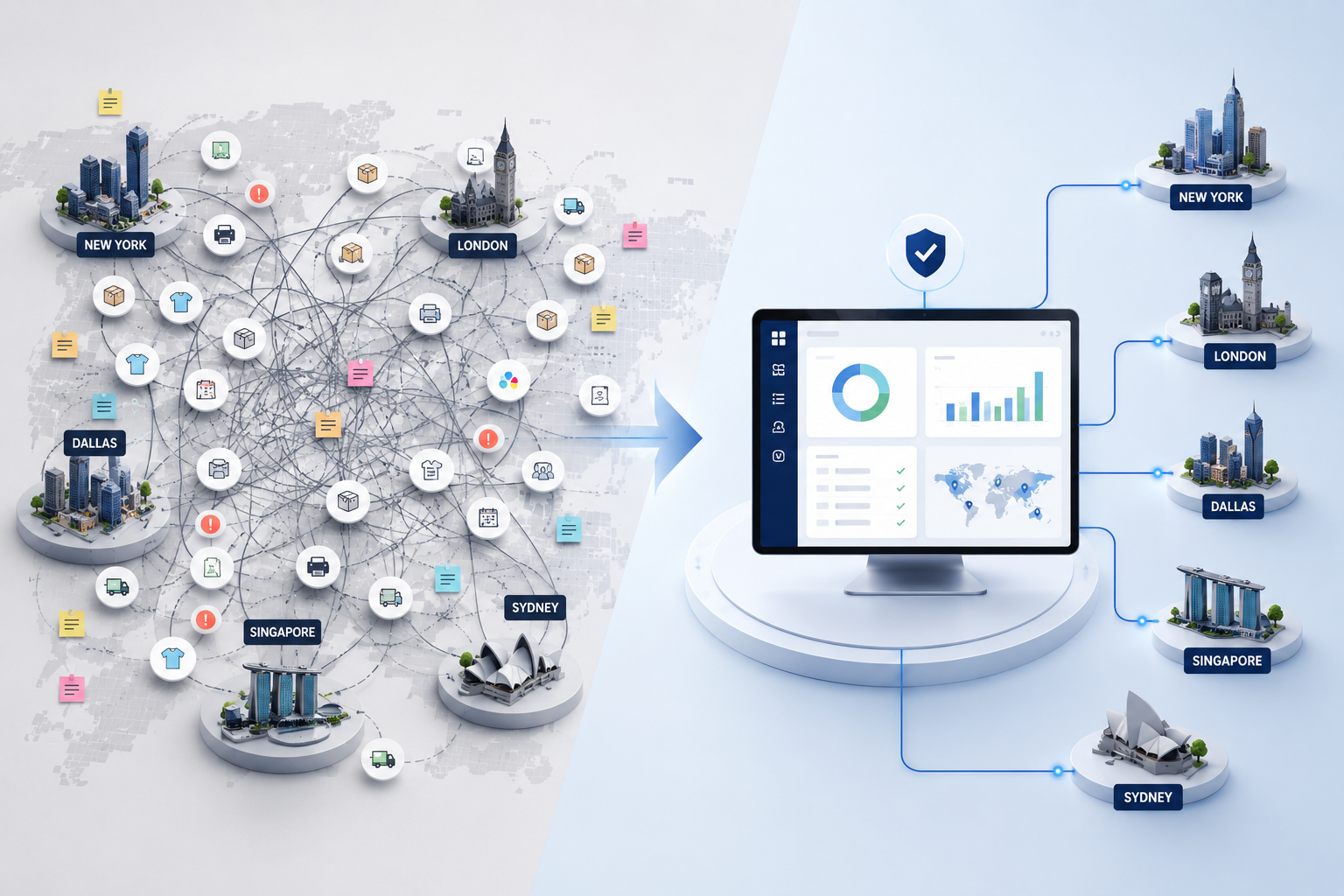
Vendor management is often treated as a traditional procurement discipline; a straightforward process of sourcing, negotiating, and paying suppliers. But in organizations operating across multiple offices, teams, and regions, it becomes something much more complex. At scale, it is no longer just about buying, but becomes a critical coordination system across people, locations, and workflows.
Most mid-market companies believe they have a functioning vendor management strategy. In reality, what they usually have is a fragmented network of multiple teams working with different vendors without shared systems or central oversight.
When you look closely at the operational reality of distributed organizations, a clear pattern emerges. Vendor management doesn’t fail because of poor individual decisions or a lack of effort from the teams involved. It fails because it was never designed to operate across distributed organizations. Without a unified system of record, what begins as a controlled process inevitably devolves into operational chaos.
Why Vendor Management Feels Simple at Small Scale
To understand why vendor management breaks down, we have to start with the illusion of control that exists early on. Most companies begin with a highly controlled environment. They rely on a small number of vendors and a centralized decision-maker to maintain clear ownership over every relationship and transaction.
For example, a centralized procurement or marketing lead might manage two or three vendors for all employee apparel, print needs, or corporate services. In this scenario, every variable is controlled, visible, and coordinated. Because the volume of requests is low and the geographic footprint is small, the primary stakeholders can easily monitor inventory, enforce brand guidelines, and track spending manually.
In these early stages, a dedicated vendor management strategy is relatively easy to maintain. The centralized team knows exactly who they are buying from, what they are paying, and what level of service to expect. This creates a false sense of security, leading leadership to believe their current procurement systems will easily adapt as the company expands.
What Changes as Organizations Grow
As organizations expand, the operational dynamics shift dramatically. Growth introduces complexity, and scale fundamentally alters how teams interact with external suppliers. When new offices open, regional teams begin to operate independently, and entirely new vendor needs emerge that the central office may not immediately recognize.
For example, regional operations teams might start sourcing local vendors to fulfill immediate project requirements, while different departments—such as HR and Marketing—begin onboarding suppliers independently to manage localized engagement programs or regional events.
The immediate result is that the vendor count increases quickly. What was once a consolidated list of three strategic partners suddenly balloons into dozens of localized suppliers. According to Deloitte’s research on supplier management, third-party ecosystems are becoming more complex than ever, yet the internal functions required to manage these networks remain vastly underpowered in most organizations. As the organization grows, the systems used to track these relationships rarely keep pace.
The Breaking Point: When Vendor Management Becomes Fragmented
There is a definitive breaking point in every growing organization where the illusion of centralized control shatters. At scale, vendor management becomes distributed, unstructured, and highly reactive.
Instead of a centralized vendor strategy dictating how resources are acquired and managed, each team begins managing its own vendors. A regional director in one office might prioritize speed of delivery, while a manager in another office prioritizes localized customization. Because there is no unified procurement infrastructure to govern these decisions, the organization loses its grip on standard operating procedures.
We see this transition consistently in mid-market organizations. The breaking point occurs when the volume of decentralized transactions surpasses the central team’s ability to monitor them. At this stage, the organization stops managing vendors and starts simply reacting to immediate demands, resulting in deep supplier fragmentation across the enterprise.
Why Vendor Management Breaks Across Multiple Offices
When vendor management fractures across distributed teams, the operational failures usually stem from a specific set of internal drivers.
Decentralized Decision-Making
Without a system enforcing a unified vendor management strategy, teams naturally begin to choose vendors independently. For example, the marketing team in one region might use Vendor A for branded materials, while another region uses Vendor B for the exact same requirements.
This happens because there are no shared standards dictating how sourcing should be handled across locations. Decentralized decision-making leads to wildly inconsistent brand execution and erratic operational workflows. In fact, McKinsey has noted that managing a large number of disjointed vendors makes standardizing performance and quality nearly impossible. When every regional office acts as its own procurement hub, the organization loses the ability to enforce quality, compliance, and strategic alignment.
Lack of Vendor Visibility
When decision-making becomes decentralized, the immediate casualty is operational visibility. There is no central tracking mechanism to monitor who is buying what and from whom.
For example, the finance department often doesn’t know how many vendors currently exist in the system, how much total capital is being spent across similar categories, or where exact duplication is happening. Deloitte’s insights on integrating procurement and finance highlight that without a holistic view of spend data and supplier performance, organizations cannot make informed strategic decisions. When visibility is lost, financial blind spots grow, and the organization assumes unnecessary financial risk.
Duplicate Vendors and Overlapping Services
A direct consequence of poor visibility is the proliferation of duplicate vendors and overlapping services. It is remarkably common for distributed organizations to have the same vendors operating under entirely different contracts for different regional offices.
Alternatively, multiple teams end up working with different printers, different swag suppliers, and different local agencies, often for identical services that could easily be centralized. This redundancy bloats the supply chain and creates administrative nightmares for accounts payable, forcing them to process hundreds of disparate invoices rather than managing a streamlined, consolidated supplier network.
Inconsistent Pricing and Terms
When teams source independently, the organization completely forfeits its purchasing leverage. Rather than combining their volume to negotiate enterprise-grade contracts, regional offices secure isolated agreements.
For example, one team might successfully negotiate bulk pricing based on their specific regional volume, while another office pays full retail price for the exact same product from a different supplier. This localized purchasing creates massive budget leakage. To understand the true financial impact of this inefficiency, organizations must evaluate what maverick spending really costs organizations and recognize that decentralized buying strips the company of its most valuable negotiating asset: scale.
Fragmented Supplier Relationships
A high volume of unmanaged suppliers inevitably leads to fragmented supplier relationships. When there is no centralized relationship ownership, vendors are forced to interact with multiple, uncoordinated stakeholders across the company.
This lack of alignment means vendors receive mixed signals, differing requirements, and conflicting priorities from the same client. The result is inconsistent service, frequent miscommunication, and missed expectations. Without a unified point of contact or a standardized platform for interaction, the burden of managing the supplier relationship shifts to regional employees who are neither trained nor equipped to act as procurement managers.
Why These Problems Accelerate in Multi-Location Organizations
These issues do not just appear in distributed organizations; they actively accelerate due to the structural realities of multi-location footprints. Distributed organizations introduce distinct challenges such as varying time zones, regional autonomy, and hyper-local sourcing needs.
For example, local teams frequently prioritize speed above all else. If a regional manager needs branded apparel for an event next week, and the central procurement process takes two weeks to navigate, they will bypass central procurement entirely and find a local shop to get the job done. This well-intentioned desire to execute quickly accelerates fragmentation. The larger the geographic footprint, the faster this bypassing behavior multiplies, compounding the volume of unmanaged vendors and eroding any remaining operational control.
The Hidden Cost of Broken Vendor Management
The consequences of this operational breakdown extend far beyond administrative headaches; they actively drain resources. The hidden costs include chronic overspending, the administrative burden of duplicate vendors, deep workflow inefficiencies, and entirely lost negotiation power.
Companies often don’t realize they are paying significantly more for the same services across different teams. They are absorbing the costs through increased invoice processing fees, redundant shipping costs, and the wasted labor hours of internal teams trying to track down rogue orders. When vendor coordination fails, the financial impact quietly erodes the bottom line month over month.
Why Traditional Vendor Management Strategies Fail at Scale
Most organizations attempt to solve this problem by applying conventional logic, but traditional vendor management strategies fundamentally fail at scale. Most standard procurement strategies assume three things: centralized control, a limited number of vendors, and clear, unified ownership.
But at scale, those foundational assumptions break entirely. A spreadsheet and a central approval process might work perfectly when an organization is managing three suppliers from a single headquarters. However, what works for three vendors does not work for 30+ vendors distributed across autonomous offices. Organizations outgrow their manual processes long before they realize it, leading to a total collapse of their vendor management strategy.
The Pattern Behind Vendor Management Failure
Across mid-market organizations, the unifying idea behind this failure is a fundamental misunderstanding of the task. Vendor management is almost universally treated as a process, instead of being engineered as a robust system.
When organizations view sourcing as a series of isolated tasks, request, approve, purchase, and pay, they fail to build the necessary infrastructure to support those tasks across locations. Without infrastructure, coordination breaks, visibility disappears, and control is ultimately lost. To maintain consistency across a distributed footprint, organizations must stop relying on manual processes and start implementing systems of record.
What Scalable Vendor Management Actually Requires
Fixing this fragmentation requires a shift in how the organization approaches external demand. Scalable systems require centralized vendor visibility, tightly controlled onboarding protocols, aggressive vendor consolidation, and clear procurement governance.
For example, instead of allowing each regional team to independently onboard local vendors, organizations must implement one system that manages vendor relationships across the entire enterprise. As we outline in our analysis of How Vendor Consolidation Reduces Operational Costs Across Distributed Teams, consolidating suppliers into a single, reliable platform eliminates redundancy, restores purchasing power, and ensures that brand quality remains consistent regardless of which office is placing the order.
Early Signs Your Vendor Management Is Breaking Down
Organizations rarely notice that their vendor management strategy is failing until the administrative pain becomes unbearable. However, there are clear diagnostic signs that precede a total breakdown.
These early indicators include having too many vendors on the ledger, identifying duplicate services across different regions, experiencing wildly inconsistent pricing for similar goods, and suffering from a general lack of visibility. The most telling diagnostic question is simple: If no one in your finance or operations team can quickly answer “how many vendors do we currently have?”, you already have a systemic problem. Multiple contracts for similar work across regions are a definitive signal that your infrastructure is lacking.
Vendor Management Doesn’t Scale Without Infrastructure
Ultimately, the solution requires a shift in perspective. Vendor management is not just about initial selection, aggressive negotiation, and maintaining friendly relationships.
To operate successfully across a distributed organization, vendor management must function as a coordination system, a visibility system, and a control system. It requires a dedicated procurement infrastructure designed to govern repeat demand. When an organization integrates its procurement requirements into one reliable system, it removes the burden of vendor management from local teams, ensuring consistency, compliance, and continuity across the entire network.
Conclusion
Vendor management almost always starts as a highly controlled, centralized function. But as organizations expand across new teams and geographic locations, operational complexity naturally increases. Without robust systems built specifically for visibility, coordination, and governance, even the best vendor management strategy will inevitably become fragmented and inefficient. Organizations that scale successfully do not just hire more procurement staff; they treat vendor management as essential enterprise infrastructure, utilizing single systems of record to keep every location aligned, efficient, and consistent.
Evaluate Your Vendor Management Infrastructure
If your organization is:
- working with too many vendors
- struggling with visibility
- duplicating services across teams
You’re not facing a sourcing issue; you’re facing a systems issue.
If your organization manages vendors across multiple teams or locations, it may be time to assess whether your vendor management strategy is supported by the systems required to scale.