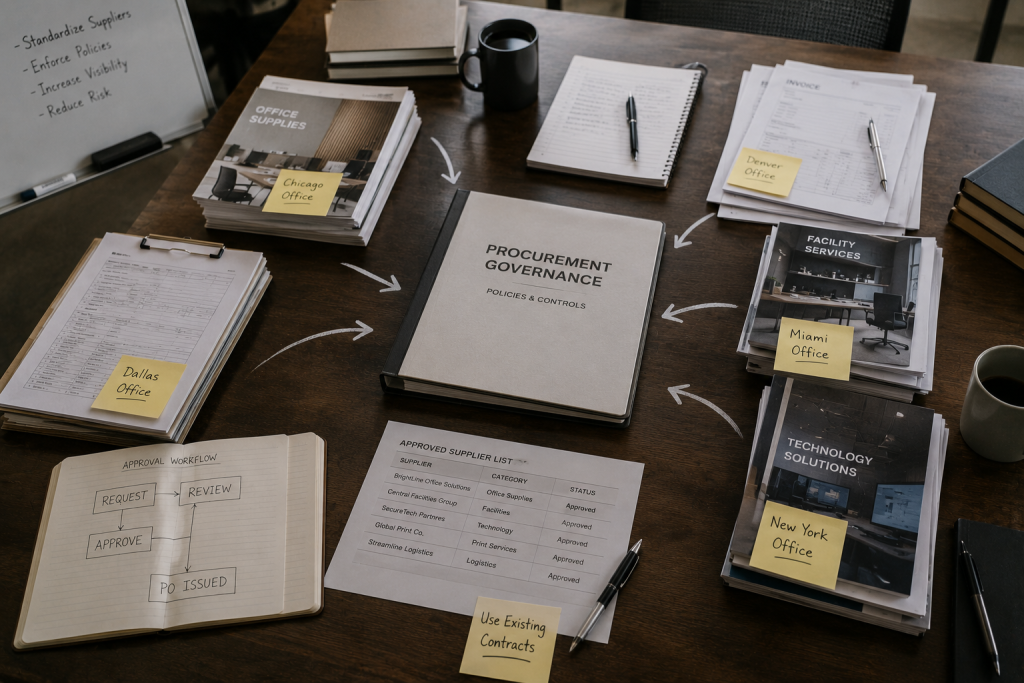
Procurement challenges rarely begin with the act of purchasing. They almost always begin with a gradual loss of control. An organization may have carefully vetted and approved vendors in place. They may have negotiated contracts and established clear purchasing processes at the corporate level. Yet as time passes and the company scales, departments inevitably begin sourcing independently. Regional offices develop their own local supplier relationships, spending becomes fragmented, and overall visibility decreases.
When leadership notices these symptoms, they often diagnose the issue as a flaw in procurement activity. In reality, it’s a symptom of a breakdown in procurement governance. As organizations grow across multiple offices and teams, governance provides the essential structure that keeps procurement operations aligned, standardized, and fully transparent. We see this daily in growing companies. Without a reliable framework to manage purchasing behavior, even the best-negotiated contracts will fail to deliver value.
What Is Procurement Governance?
Procurement governance refers to the policies, processes, controls, and accountability structures that guide purchasing decisions across an organization. It provides the operational rulebook for how a company acquires goods and services.
This framework dictates exactly who is authorized to make a purchase, which specific suppliers they are allowed to use, how those purchasing decisions are approved, how spending is continually monitored, and how supplier relationships are actively managed.
While the procurement process handles the actual execution of buying materials, procurement governance controls how that execution happens. It ensures that every transaction aligns with corporate strategy, mitigates risk, and maximizes financial leverage. Without this overarching control, purchasing happens in a vacuum where local teams make decisions based entirely on immediate convenience rather than long-term organizational value.
Why Procurement Governance Becomes Important as Organizations Grow
Smaller organizations often operate effectively with informal purchasing processes. When a company operates out of a single building, leaders can easily monitor spend and approve vendor relationships through simple communication. However, growth introduces immediate operational complexity.
As organizations add new offices, specialized departments, regional teams, and autonomous business units, each distinct group naturally develops its own purchasing needs. Without a formalized system of procurement controls in place, supplier counts rapidly increase. Purchasing processes diverge from location to location, and spending becomes incredibly difficult to track at the corporate level. The fundamental challenge for leadership shifts away from simply purchasing efficiently. The new challenge becomes managing that purchasing consistently across a decentralized landscape.
The Hidden Problems Procurement Governance Solves
Many organizations experience operational symptoms long before they formally recognize that a governance problem exists. These pain points often masquerade as budget overruns or vendor quality issues.
Common examples include massive vendor sprawl, rampant maverick spend, duplicate purchasing efforts across different teams, highly inconsistent supplier relationships, and severely limited spend visibility. For instance, leadership might suddenly discover dozens of overlapping suppliers performing the exact same work across the organization. Procurement problems often appear to be supplier problems on the surface, but they are fundamentally governance problems at their core.
How Weak Procurement Governance Creates Vendor Sprawl
When an organization lacks strict purchasing governance, departments select suppliers entirely independently. Local purchasing decisions multiply rapidly as teams prioritize speed over compliance. This localized behavior causes supplier counts to grow uncontrollably.
Over time, organizations lose their purchasing leverage, their ability to drive procurement standardization, and their centralized visibility. A strong procurement management strategy prevents this by enforcing rules around vendor onboarding and utilization. We highly recommend reading our detailed breakdown on the hidden cost of managing too many vendors to understand exactly how much capital is wasted when organizations allow supplier counts to multiply unchecked. Effective vendor governance forces teams to utilize existing relationships, ultimately protecting the organization’s purchasing power.
Why Multi-Location Organizations Face Greater Governance Challenges
Organizations navigating multi-location procurement face incredibly unique challenges. Regional autonomy often clashes with corporate standardization goals, leading to local supplier preferences, highly decentralized purchasing decisions, and widely varying approval processes.
Local Purchasing Behavior
Regional teams naturally solve local problems independently when corporate systems create friction. A classic example we see constantly involves a regional office sourcing branded merchandise from a local vendor completely outside approved supplier programs. They do this because they need items quickly for an event and the corporate system is too slow or overly complex.
Inconsistent Supplier Relationships
Different locations frequently use entirely different vendors for the exact same operational needs. You might see multiple locations purchasing the identical category of products from completely different suppliers at drastically different prices. This lack of supplier governance destroys any opportunity for volume discounting and guarantees an inconsistent final product.
Limited Visibility Across Locations
When every location manages its own vendors, leadership completely loses the ability to understand total spend and supplier activity. Data becomes siloed in regional spreadsheets or hidden in localized expense reports. You can explore how to solve this specific visibility gap in our guide detailing why supplier relationships fragment with multi-location procurement.
The Core Components of Procurement Governance
Building a reliable system requires implementing specific operational structures. When we help clients build procurement infrastructure, we focus on five distinct components.
Procurement Policies
These are the strict, documented rules that guide all purchasing activity. Procurement policies define spending limits, sourcing requirements, contract standards, and the specific conditions under which an employee can initiate a purchase.
Approved Supplier Programs
These programs establish the structures that define preferred vendors. An approved supplier framework strictly limits purchasing to a heavily vetted pool of partners, ensuring that all vendors meet corporate standards for quality, pricing, and compliance before a single dollar is spent.
Approval Workflows
These are the digital controls that support purchasing decisions. Standardized approval workflows ensure that requests automatically route to the correct managers, finance leaders, or procurement directors based on the specific dollar amount or category of the request.
Procurement Visibility
Visibility relies on systems that provide comprehensive procurement oversight. Organizations need centralized digital dashboards that track exactly what is being ordered, who is placing the order, and which vendors are receiving the capital in real time.
Accountability Structures
Procurement accountability requires clear ownership and documented governance responsibilities. This ensures that specific individuals or teams are explicitly responsible for enforcing policies, auditing procurement compliance, and managing the overall health of the procurement ecosystem.
How Procurement Governance Supports Vendor Consolidation
Many organizations attempt major vendor consolidation initiatives to cut costs. However, these consolidation efforts frequently fail within the first year without proper governance in place.
Consolidation fails because underlying purchasing behaviors remain entirely decentralized. If you cut your vendor list in half but leave the door open for regional managers to easily add new local suppliers, the sprawl will immediately return. We see this often when marketing, human resources, and operations teams each maintain completely separate supplier relationships for similar needs like apparel, print, and recognition items.
Governance supports permanent consolidation by creating approved supplier frameworks, rigid purchasing controls, accountability mechanisms, and total procurement visibility. Organizations sustain these efforts through procurement oversight rather than relying solely on newly negotiated contracts. For a deeper look at the financial impact of these initiatives, review our insights on how vendor consolidation reduces operational costs across distributed teams.
Early Signs Your Organization May Need Stronger Procurement Governance
Because procurement drift happens slowly, recognizing the early warning signs is vital for operational leaders. The symptoms of failing infrastructure usually show up in the daily workflows of your finance and operations teams.
Warning signs include rapidly increasing supplier counts in your accounts payable system, inconsistent purchasing processes across different regional offices, frequent off-contract spending, poor spend visibility, duplicate purchases for the exact same items, and massive supplier overlap with multi-location procurement. Organizations often identify these frustrating symptoms long before they recognize the actual governance issue underneath them. If you are constantly fielding questions about rogue spending, explore what maverick spend really costs organizations across multiple offices to understand the immediate financial impact, or review why vendor management breaks down to identify the specific failure points in your current operations.
What Effective Procurement Governance Looks Like
When organizations implement the right systems, the daily operational reality transforms completely. Effective organizations typically operate with approved supplier frameworks, highly standardized purchasing processes, total procurement visibility, centralized reporting, and crystal clear accountability.
According to recent data from Deloitte’s Global Chief Procurement Officer Survey, top-performing procurement teams differentiate themselves by heavily investing in digital operating models that provide extreme visibility and strict governance over their supplier ecosystems. The ultimate goal of this framework is to create robust control while simultaneously supporting the speed and flexibility required for regional growth.
Procurement Governance Is Infrastructure, Not Administration
Many organizations incorrectly view governance as an administrative burden or a collection of restrictive paperwork. In reality, these controls function as critical operational infrastructure.
Strong governance supports absolute procurement consistency, strategic supplier management, total spend visibility, permanent vendor consolidation, and strict purchasing accountability. Thus, organizations need to shift away from purely transactional purchasing and build formalized procurement management structures to remain competitive. By treating compliance and control as a core operational capability, governance allows procurement operations to scale safely alongside the broader business.
Conclusion
Procurement governance is frequently overlooked because organizations tend to focus heavily on the daily activity of purchasing rather than the overarching control of that purchasing.
As organizations expand across various offices, specialized teams, and new suppliers, establishing reliable governance becomes increasingly vital to the health of the business. Without these controls in place, supplier relationships rapidly fragment, vendor counts grow uncontrollably, and corporate spending becomes incredibly difficult to manage. Organizations that successfully scale their procurement operations rely heavily on rigid frameworks. They build the exact systems needed to govern procurement effectively and protect their operational budget.
Evaluate Your Procurement Governance Structure
If multiple offices, departments, or teams within your organization are constantly purchasing from different suppliers, procurement governance may be the exact missing structure needed to improve visibility, support vendor consolidation, and create lasting operational control.